




Choosing an ecommerce platform is one of the most consequential decisions an online business can make. The platform influences website performance, customer experience, operational efficiency, marketing capabilities, payment processing, security, scalability, and long-term technology costs.
Among the most established options, Shopify vs WooCommerce remains one of the most widely discussed comparisons. Both platforms can support serious ecommerce operations, yet they approach online retail from fundamentally different directions. Shopify is a hosted commerce platform designed to simplify infrastructure and store management. WooCommerce is an open-source ecommerce solution built into WordPress, giving businesses considerably more control over their website architecture.
The right choice therefore depends less on which platform has more features and more on how those features align with a company's commercial model, technical resources, growth plans, and digital strategy.
How This Guide Was Researched
This guide compares the two platforms’ operating models, ecommerce features and practical requirements, using official sources including Shopify’s pricing information, its plan documentation and WooCommerce’s pricing guidance. It considers cost, ownership, content, checkout, security, integrations and maintenance. This is a requirements comparison, rather than a measured performance benchmark.
Shopify and WooCommerce: Two Different Ecommerce Philosophies
The fundamental difference between Shopify and WooCommerce is the way each platform handles infrastructure. Shopify provides a hosted environment. Businesses subscribe to a Shopify plan and receive hosting, ecommerce functionality, security infrastructure, checkout technology, technical maintenance, and a central administration system. This model reduces the amount of technical management required from the store owner.
WooCommerce follows an open-source model. The core WooCommerce software is free, although a business normally pays for hosting, a domain, payment processing, extensions, premium themes, development, and ongoing maintenance. This structure gives merchants significantly greater control over their technology stack.
In practical terms, shopify or woocommerce becomes a question of priorities. A business seeking operational simplicity may value Shopify's managed environment. A business seeking extensive ownership and customisation may prefer WooCommerce.
Shopify
One platform, fewer infrastructure decisions.
WooCommerce
Your stack, with a wider range of choices.
Shopify vs WooCommerce Comparison at a Glance
| Business Factor | Shopify | WooCommerce |
|---|---|---|
| Platform model | Hosted SaaS | Open-source WordPress plugin |
| Core platform cost | Subscription-based | Free core software |
| Hosting | Included | Purchased separately |
| Technical control | Moderate | Very high |
| Customisation | Extensive through themes, apps and APIs | Extensive through code, plugins and themes |
| Ease of setup | Generally straightforward | Requires more configuration |
| Content management | Good | Excellent through WordPress |
| SEO flexibility | Strong | Very extensive |
| Security management | Primarily platform-managed | Merchant/hosting/developer managed |
| Scalability | Strong | Strong with suitable infrastructure |
| Maintenance | Lower | Higher |
| Checkout control | More structured | Highly customisable |
| Best suited to | Businesses prioritising simplicity | Businesses prioritising ownership and flexibility |
This shopify vs woocommerce comparison shows why neither platform should be assessed solely on subscription price.
Shopify: A Managed Ecommerce Ecosystem

Shopify's principal advantage is operational simplicity. The infrastructure is managed within the platform, allowing merchants to concentrate on merchandising, marketing, customer acquisition, and sales rather than server administration.
Shopify’s published US annual-billing prices list Basic at $29 per month, Grow at $79 and Advanced at $299. Shopify Plus pricing depends on the agreement and billing term. Monthly billing, payment fees and optional apps can increase the total. Check Shopify’s current pricing for your region before budgeting.
The platform also supports unlimited products, multiple sales channels, inventory management, analytics, international selling, themes, applications, and integrated payment functionality. For a growing retailer, this creates a relatively predictable operational environment. Shopify is particularly attractive for businesses where speed-to-market matters. A company can launch a professionally designed store without separately arranging hosting, configuring WordPress, installing ecommerce software, or managing server security.
The trade-off is that Shopify operates within a more controlled ecosystem. Certain advanced customisations, checkout modifications, integrations, and platform-level changes can require specific plans, applications, or development approaches.
WooCommerce: Ownership, Flexibility and Control
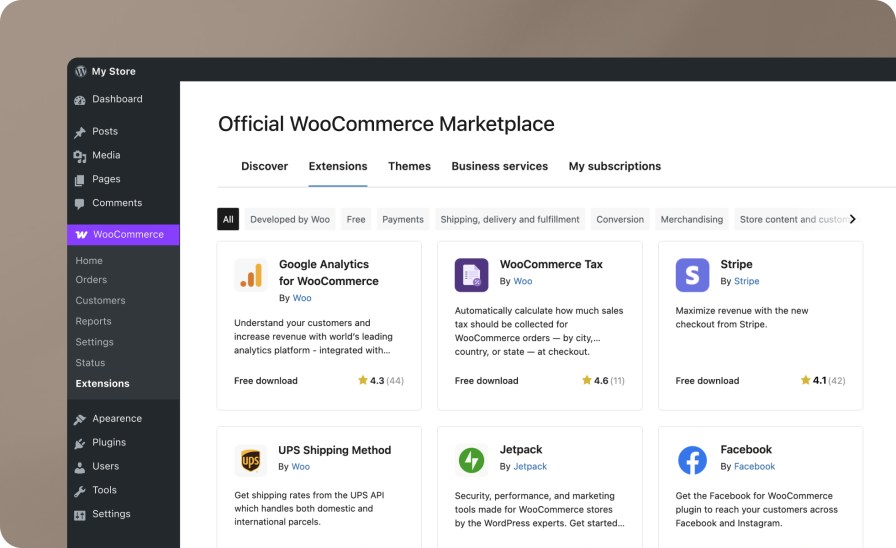
WooCommerce takes a fundamentally different approach. The core platform has no monthly subscription fee and no platform revenue share. However, businesses must account for hosting, domain registration, extensions, development, security, backups, and maintenance.
Hosting and extension costs vary with the provider, traffic, functionality and support required. Use WooCommerce’s pricing guidance and cost estimator to build a budget around your own requirements, rather than treating a generic monthly range as a quote. This makes woocommerce vs shopify pricing more nuanced than simply comparing a free platform with a paid platform.
WooCommerce becomes particularly compelling for businesses already operating on WordPress. It allows ecommerce functionality to sit alongside blogs, editorial content, landing pages, resources, guides, and sophisticated content marketing.
Its open-source architecture also provides considerable freedom. Developers can modify the code, integrate external systems, customise checkout experiences, select hosting providers, and create highly specialised ecommerce workflows. For technically capable businesses, this flexibility can become a significant strategic asset.
WooCommerce vs Shopify Cost Comparison 2026
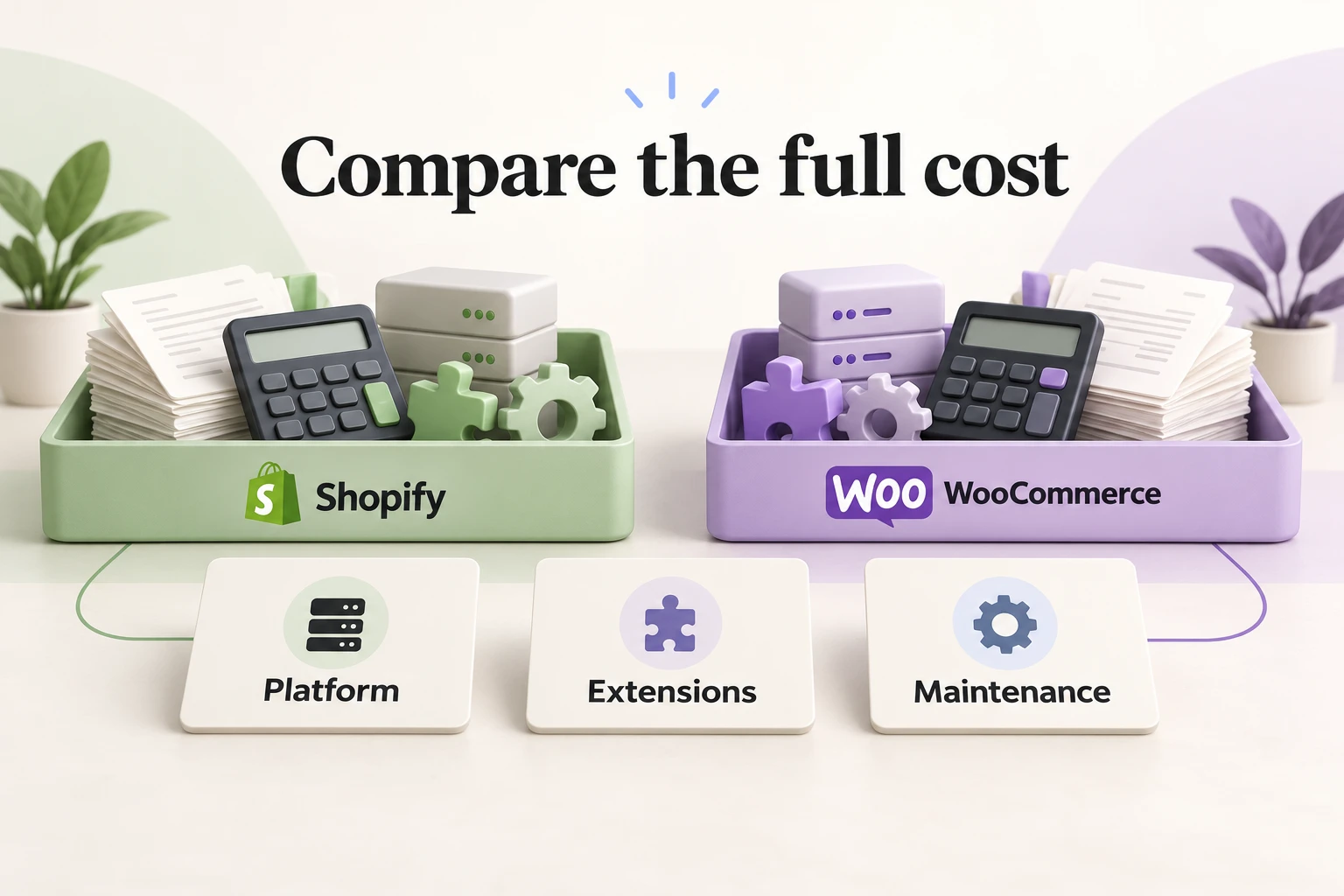
The woocommerce vs shopify cost comparison 2026 requires an assessment of total cost of ownership rather than headline subscription fees. Shopify's cost structure is relatively straightforward. A business pays its platform subscription and transaction or payment processing costs, then adds optional applications and services where required.
WooCommerce starts with a free core platform, but the final investment depends on the infrastructure and functionality selected. Typical WooCommerce expenditure may include:
- Hosting
- Domain registration
- Premium themes
- Paid extensions
- Payment processing
- Developer support
- Security services
- Backup systems
- Performance optimisation
- Maintenance
Therefore, a small WooCommerce store can be inexpensive, while a sophisticated enterprise implementation can require substantial investment. Shopify follows a more predictable commercial model, whereas WooCommerce allows businesses to construct their own technology stack.
Shopify vs WooCommerce Security Comparison

Security deserves particular attention because ecommerce stores process customer information, payment data, addresses, order details, and other commercially sensitive information. A shopify vs woocommerce security comparison reveals different responsibilities.
Shopify manages much of the underlying platform infrastructure. The merchant still needs to maintain strong passwords, staff permissions, secure applications, reliable payment practices, and appropriate operational controls. However, the hosting environment itself is managed by Shopify.
WooCommerce security is more distributed. The WordPress installation, hosting environment, plugins, themes, passwords, updates, backups, firewall configuration, and other technical components require proper management. This does not mean that WooCommerce is inherently insecure. A professionally maintained WooCommerce store can have a robust security architecture. The distinction is responsibility: WooCommerce provides flexibility, while the business or its technical partner must manage more of the environment.
This answers the question, how do Shopify and WooCommerce compare on security and performance: Shopify generally reduces infrastructure responsibility, while WooCommerce provides greater control over how the infrastructure is designed.
Performance and Scalability
Performance affects both customer experience and conversion potential. Shopify benefits from a managed infrastructure designed specifically for commerce. Businesses do not generally need to select servers or optimise database architecture themselves.
WooCommerce performance depends heavily on hosting quality, theme architecture, plugin selection, database optimisation, caching, image compression, content delivery, and development practices. A carefully engineered WooCommerce store can perform extremely well. However, poorly configured plugins or inexpensive hosting can create bottlenecks.
For high-volume businesses, scalability therefore depends on architecture rather than the ecommerce software alone. The broader shopify woocommerce debate should consequently focus on operational requirements instead of simplistic claims that one platform is universally faster.
SEO: Shopify or WooCommerce?
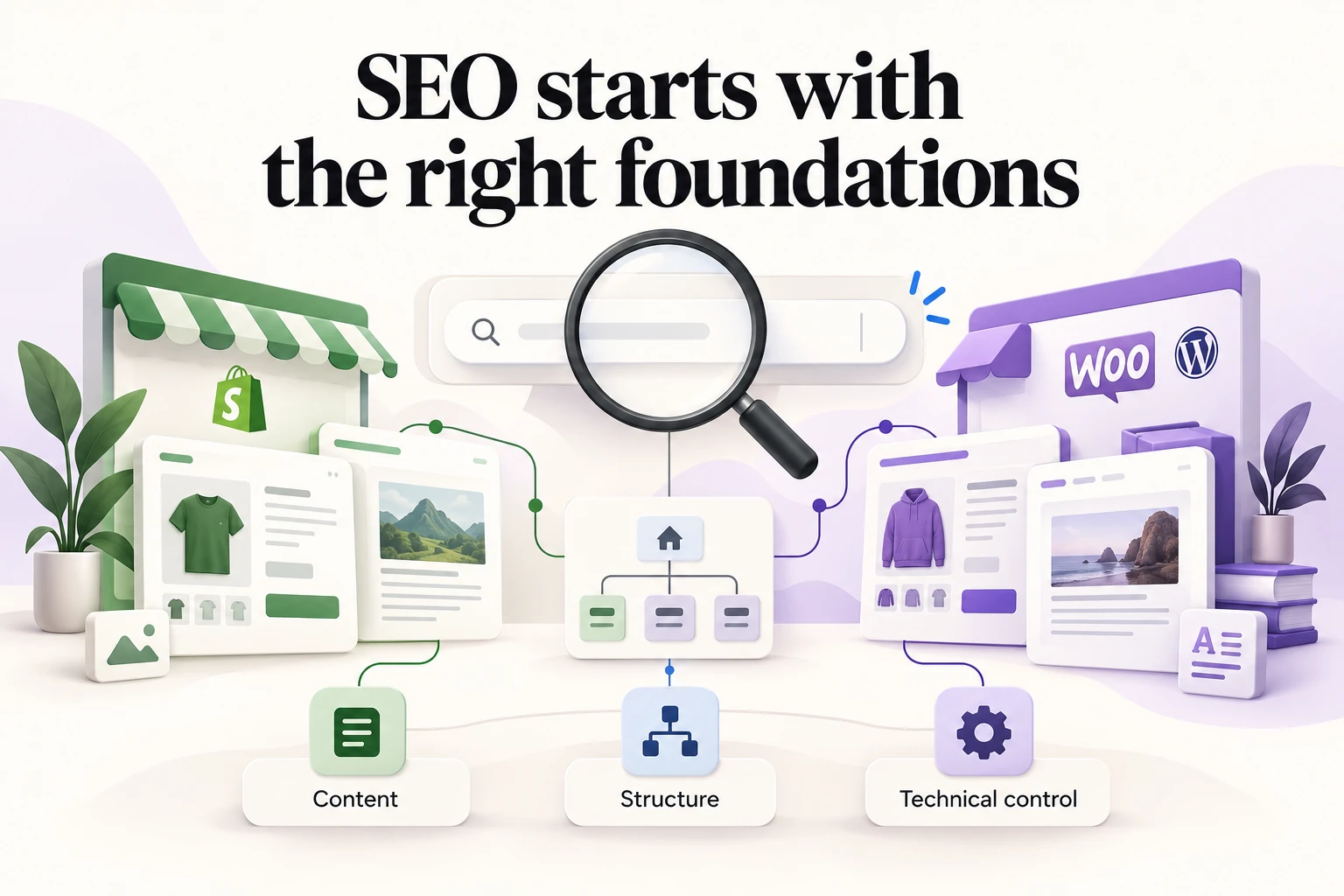
Search engine optimisation is another area where the platforms take different approaches. WooCommerce benefits from WordPress's exceptional content-management capabilities. Businesses can create detailed editorial strategies, category structures, long-form resources, internal linking systems, schema implementations, and extensive content libraries. This is one reason wordpress woocommerce vs shopify continues to be a significant consideration for content-led brands.
Shopify also provides strong SEO foundations. Merchants can manage titles, descriptions, URLs, redirects, structured content, image optimisation, collections, products, blogs, and other important SEO elements. However, WooCommerce typically offers greater technical freedom because developers have direct access to the WordPress environment.
For SEO, compare technical flexibility, content requirements, development resources and publishing strategy against what your team can maintain. Evaluate the complete marketing ecosystem, including integrations, measurement and the publishing workflow, rather than SEO in isolation.
Shopify vs WooCommerce for Marketing

Modern ecommerce marketing extends beyond organic search. Both platforms can integrate with:
- Google Shopping
- Meta advertising
- Email marketing platforms
- Analytics systems
- Customer relationship management tools
- Affiliate platforms
- Social commerce channels
- Marketplace integrations
- Retargeting systems
Shopify's app ecosystem makes integrations relatively accessible. WooCommerce offers comparable flexibility through plugins and third-party integrations.
For content-heavy businesses, WordPress can offer a particularly strong environment for publishing and organic acquisition. For brands focused heavily on product launches, paid advertising, social selling, and streamlined commerce operations, Shopify provides an integrated environment designed around those activities.
WooCommerce Pros and Cons
Understanding the woocommerce pros and cons helps businesses assess whether its flexibility aligns with their resources.
Key Advantages of WooCommerce
WooCommerce offers:
- No core monthly platform subscription
- Extensive ownership of website data and infrastructure
- Exceptional design flexibility
- Deep WordPress integration
- Broad plugin and extension availability
- Strong content marketing capabilities
- Flexible payment gateway selection
- Extensive developer control
- Customisable checkout and customer journeys
- Support for highly specialised ecommerce models
Potential Challenges
The same flexibility can create additional responsibility. Businesses may need to manage:
- Hosting
- Updates
- Plugin compatibility
- Security
- Backups
- Performance
- Technical maintenance
- Developer relationships
WooCommerce can therefore be highly capable without necessarily being the simplest option for a business without technical resources.
Before You Migrate: Check the Full Buying Journey
A successful platform demonstration is only the first step. Use a written acceptance checklist to confirm that your data, customers and day-to-day operations can move with the store.
Inventory the data and keep a recovery copy
List the products, variants, customers, orders and content you need to retain. Confirm what can be transferred, what needs an app or specialist support, and how you will recover the source data.
Map important pages and redirects
Prioritise pages with traffic, sales or external links. Record each old URL and its intended destination, then test the redirects as part of the launch checks.
Test an order from payment to fulfilment
Check payment, tax, shipping, confirmation messages, inventory updates and connected systems. Include cancellation and refund scenarios appropriate to your setup.
Assign ownership after launch
Name the person or partner responsible for store access, integrations, backups and incident handling. For WooCommerce, include software updates and compatibility testing in that agreement.
Platform guidance: Shopify migration guide, test orders and WooCommerce security best practices.
Can WooCommerce and Shopify Work Together?
Some businesses explore using WooCommerce and Shopify together because they want specific strengths from both ecosystems. A company may operate WordPress and WooCommerce for its primary content strategy while using Shopify for particular commerce initiatives. Others may migrate selected product operations or use integrations to connect different systems.
However, running both platforms introduces additional complexity. Product synchronisation, inventory management, customer data, analytics, order management, and integrations must be carefully coordinated. Therefore, woocommerce and shopify should only coexist when there is a clear commercial or technical reason.
WooCommerce or Shopify: Which Business Model Fits Each Platform?
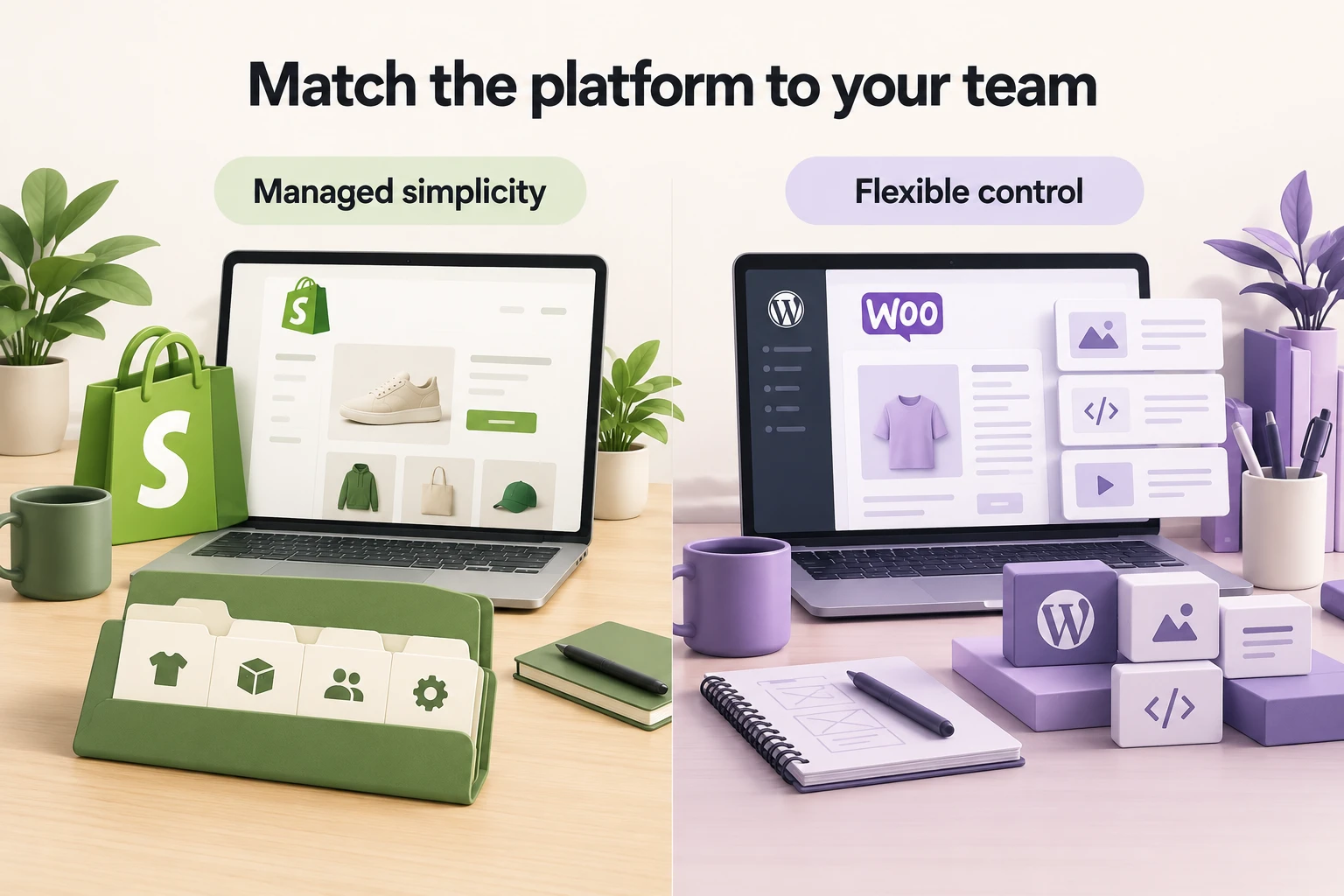
The question woocommerce or shopify becomes easier when business requirements are clearly defined. Shopify can suit:
- New ecommerce ventures
- Fast-growing retail brands
- Businesses with limited technical resources
- Omnichannel sellers
- Businesses seeking predictable infrastructure
- Brands prioritising rapid deployment
WooCommerce can suit:
- WordPress-based businesses
- Content-driven ecommerce brands
- Businesses requiring extensive customisation
- Companies with developer support
- Complex editorial and commerce websites
- Brands seeking greater control over hosting and infrastructure
Neither model is inherently appropriate for every business.
Platform Choice in Practice: Two Business Scenarios
The same platform can be a sensible choice for one team and an expensive distraction for another. These examples show how priorities change the shortlist.
A small team launching a product brand
The business has a conventional catalogue, wants to launch quickly and has no in-house developer. Its priority is a store the team can operate reliably.
Starting shortlist: Shopify. Validate the required payments, shipping and app costs before choosing a plan.
Question to resolve: can the store’s essential workflows work within the available plans and integrations?
A WordPress business with specialist workflows
The business already publishes substantial content, needs tailored product journeys and has a technical partner able to support development and maintenance.
Starting shortlist: WooCommerce. Validate hosting, extension compatibility and ongoing support costs.
Question to resolve: who owns updates, testing, backups and performance after launch?
WooCommerce vs Shopify Reddit Discussions and Real-World Opinions
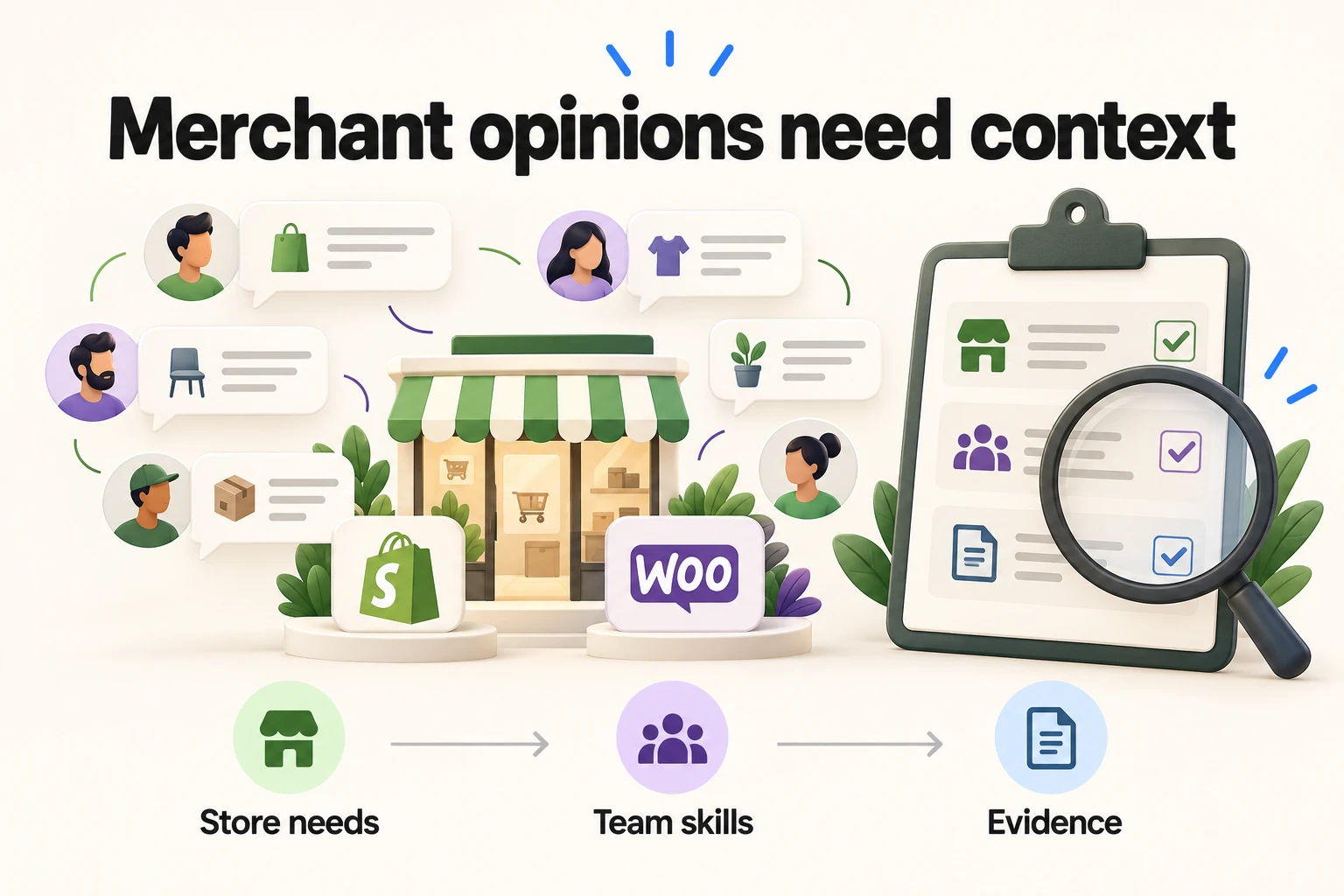
Searches for woocommerce vs shopify reddit often reveal a broad range of merchant experiences. Some users value Shopify for its simplicity, support, and reduced technical maintenance. Others favour WooCommerce because they appreciate its ownership, flexibility, and WordPress integration.
Such discussions can provide useful practical perspectives, but individual experiences should not be treated as universal evidence. A store owner's experience can be heavily influenced by hosting, developer quality, plugin selection, traffic levels, business model, and technical knowledge.
The same principle applies when comparing either platform with BigCommerce or Squarespace. Base the selection on documented requirements and test critical workflows before committing.
Shopify vs WooCommerce Cost: The Strategic Perspective
Design, development, migration and integrations.
Platform, hosting, apps, payment fees and maintenance.
New features, optimisation, training and team time.
Compare the same requirements over 12 months. A lower entry price does not automatically mean a lower running cost.
Cost should ultimately be measured against business value. A $29 monthly Shopify subscription may represent excellent operational value for one business and insufficient flexibility for another. Similarly, a free WooCommerce installation may become expensive if a company requires extensive development, premium plugins, enterprise hosting, and continuous technical support.
The objective is not simply to minimise software expenditure. It is to create a commercially sustainable ecommerce environment. For businesses conducting a detailed woocommerce vs shopify pricing assessment, the following costs should be considered:
- Platform fees
- Hosting
- Payment processing
- Applications and extensions
- Development
- Maintenance
- Security
- Performance optimisation
- Migration
- Staff time
This produces a more meaningful total-cost assessment.
How EcommAdvize Can Support Ecommerce Platform Decisions
Platform selection should form part of a broader ecommerce strategy rather than being treated as an isolated technical decision. At EcommAdvize, businesses can assess their ecommerce requirements from a commercial, technical, UX, SEO, and growth perspective. The objective is to establish a technology foundation that supports customer acquisition, conversion, operational efficiency, and sustainable expansion.
For businesses considering migration, redevelopment, or a new ecommerce launch, EcommAdvize can help evaluate the practical implications of Shopify, WooCommerce, and other leading platforms before significant development resources are committed. This approach is particularly valuable when the business has complex catalogues, multiple sales channels, international customers, content-led acquisition, or ambitious growth targets.
Final Verdict: Shopify or WooCommerce?
There is no universal answer to shopify versus woocommerce because the platforms solve different operational problems. Shopify prioritises managed infrastructure, streamlined administration, integrated commerce functionality, and rapid deployment. WooCommerce prioritises ownership, flexibility, WordPress integration, and technical control.
The most effective decision comes from evaluating the complete commercial picture: budget, product catalogue, traffic expectations, SEO strategy, marketing channels, integrations, security responsibilities, development resources, international requirements, and long-term growth plans.
Ultimately, the shopify versus woocommerce decision should not be based on which platform is more popular. It should be based on which technology model gives the business the appropriate balance of control, efficiency, performance, cost, and scalability.
For businesses that require a structured assessment before investing in a new store or migration, EcommAdvize.com provides a strategic starting point for evaluating ecommerce development and growth requirements.
Pricing and plan references checked on 21 October 2026. Prices and features can vary by country and billing term.
- Shopify pricing and plan documentation
- WooCommerce pricing and total-cost guidance
- Original product visuals: Shopify and WooCommerce. Product and brand assets belong to their respective owners.


