




Introduction
An online store is no longer simply a digital catalogue with a checkout button. Modern customers expect fast pages, intuitive navigation, personalized experiences, secure payments and friction-free purchasing across phones, tablets and desktops. For businesses competing in crowded markets, the quality of the digital storefront can directly influence visibility, engagement and sales.
The global ecommerce market demonstrates why businesses continue to invest in stronger digital infrastructure. Global retail ecommerce sales were forecast at approximately $6.42 trillion in 2025, with the figure expected to reach around $6.88 trillion in 2026. Ecommerce is also projected to represent 21.1% of global retail sales in 2026.
The US market provides another useful benchmark. According to the US Census Bureau’s August 18 release, ecommerce sales reached an estimated $340.2 billion in Q2 2026, representing 17.1% of total retail sales for the quarter. Ecommerce sales increased 12.2% compared with Q2 2025. These are the August-release estimates; the Census Bureau subsequently flagged them for revision. See the US Census Bureau ecommerce report for the latest release.
These figures highlight a simple reality: an ecommerce store needs to perform like a business system, not just look attractive.
This guide explores ecommerce website development, the technologies behind it, development approaches, important features, ecommerce architecture, platform selection, security, SEO, testing and long-term optimisation.
How This Guide Was Researched
This guide was prepared using current ecommerce industry information, platform documentation and recent market statistics. Research included reviewing current ecommerce development practices, examining BigCommerce's technical guidance around storefront architecture, APIs, integrations and replatforming, and checking recent ecommerce sales data from recognised industry and government sources. The research also considered how modern businesses approach performance, mobile experiences, security, scalability and technology selection rather than focusing only on visual design.
What Is Ecommerce Website Development?
Ecommerce website development is the process of planning, designing, building, testing and maintaining an online store. It covers both the customer-facing storefront and the technical systems operating behind it.
At the front end, customers interact with product pages, navigation menus, search functions, filters, shopping carts and checkout pages. At the back end, the system manages products, customers, orders, payments, inventory and integrations.
Effective ecommerce development therefore connects design with technology and business operations.
A typical project may involve:
- Storefront design and development
- Product catalogue management
- Shopping cart functionality
- Secure checkout
- Payment integration
- Inventory synchronisation
- Shipping integration
- Customer accounts
- Search and filtering
- Analytics
- Content management
- SEO implementation
- Security controls
- Third-party integrations
Modern ecommerce web development also increasingly involves APIs, cloud services, automation and headless technologies.
Why Ecommerce Development Has Become More Complex
Early online stores could operate with relatively simple catalogues and payment systems. Today's businesses often sell hundreds or thousands of products across multiple channels.
A growing retailer might need its website connected to an ERP, CRM, warehouse management platform, accounting software, email marketing platform, payment provider and delivery network.
This makes e-commerce development more than a design exercise.
The development team must understand how each component communicates with another. Poorly planned integrations can create duplicated data, incorrect stock levels, slow checkout experiences and operational problems.
For this reason, businesses increasingly need a clear technical strategy before development begins.
The Core Components of a Modern Ecommerce Store
1. User Experience and Interface
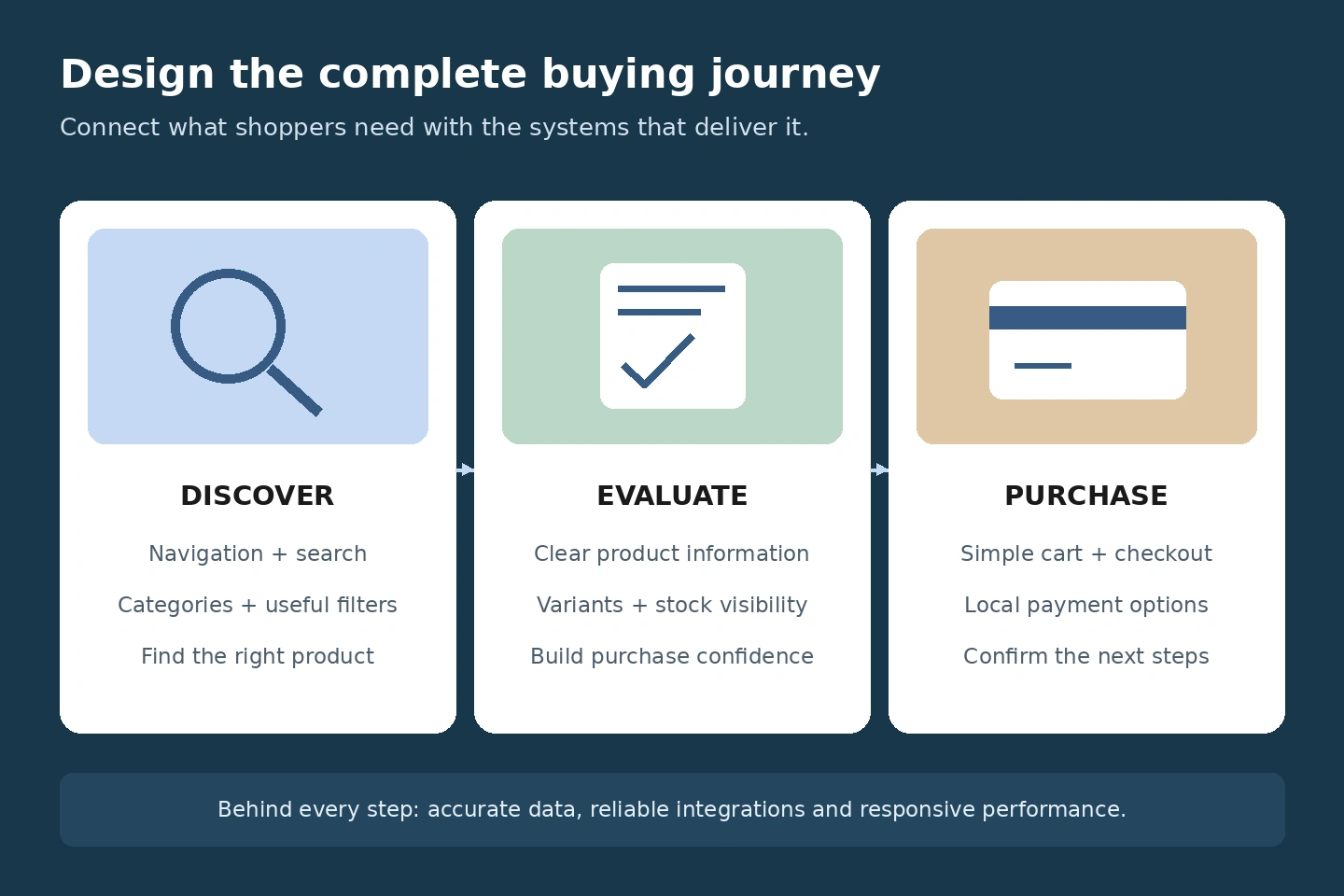
The storefront should make purchasing straightforward.
Customers need to find products quickly, understand product information and complete purchases without unnecessary steps. Clear categories, strong product photography, useful filters and simple checkout flows can reduce friction.
A strong custom ecommerce web design approach starts with customer behaviour rather than decoration.
2. Product Catalogue
The catalogue forms the foundation of an ecommerce store.
It should support product names, descriptions, images, prices, variants, stock status, specifications and categories. Large catalogues may also require advanced search and filtering.
A well-structured catalogue benefits customers and search engines at the same time.
3. Shopping Cart and Checkout
The checkout process needs to be reliable, responsive and secure.
Common functionality includes:
- Guest checkout
- Customer accounts
- Multiple payment options
- Discount codes
- Shipping calculations
- Tax calculations
- Order confirmation
- Address management
Reducing unnecessary checkout steps can create a smoother purchasing experience.
4. Payment Integration
Payment systems must be selected according to the target market.
Depending on the location and business model, an ecommerce store might support cards, digital wallets, bank payments, buy-now-pay-later services or local payment methods.
Payment security must remain a priority throughout ecommerce site development.
Choosing the Right Ecommerce Technology
Technology selection has a major impact on development costs, flexibility and future growth.
A business can choose from SaaS platforms, open-source systems, headless commerce frameworks or fully customised applications.
The correct choice depends on the company's size, product catalogue, technical requirements, budget and growth plans.
SaaS Ecommerce Platforms
SaaS platforms provide hosting and much of the underlying infrastructure. They can reduce technical maintenance and allow businesses to launch faster.
This approach can work particularly well for startups and growing retailers that do not require extensive backend customisation.
Open-Source Ecommerce
Open-source platforms provide greater control over the underlying code.
They can support complex requirements, although businesses may need to manage hosting, updates, security and technical maintenance.
Headless Commerce
Headless commerce separates the presentation layer from the commerce backend.
This allows businesses to use different front-end technologies while retaining the underlying commerce platform. It can be useful for brands creating experiences across websites, mobile applications, kiosks and other digital channels.
Understanding the Ecommerce Tech Stack
An ecommerce tech stack is the collection of technologies used to operate an online store.
It may include:
- Front-end framework
- Backend programming language
- Ecommerce platform
- Database
- Content management system
- Payment gateway
- Search technology
- Hosting infrastructure
- Analytics tools
- CRM
- ERP
- Marketing automation
- Security services
The stack should support current requirements without making future development unnecessarily difficult.
A strong ecommerce architecture also separates important functions logically. This can make systems easier to maintain and scale.
Custom Ecommerce Development vs Template-Based Stores
Not every business needs a completely customised platform.
For a small retailer with a straightforward catalogue, a professionally configured ecommerce platform may be sufficient.
However, larger companies may require custom ecommerce development because their operations cannot be supported efficiently by standard features alone.
Customisation can be useful when a business needs:
- Complex product configurators
- Unique pricing systems
- Subscription models
- Custom checkout workflows
- Advanced customer portals
- Bespoke inventory logic
- Special marketplace integrations
- Complex B2B purchasing
- Custom reporting
Custom ecommerce website development allows these requirements to be designed around the business rather than forcing the business to change its processes around a generic system.
What Does an Ecommerce Website Developer Do?
An ecommerce website developer is responsible for translating business and design requirements into a functional online store.
Depending on the project, the developer may work on front-end interfaces, backend functionality, APIs, databases, integrations, performance and security.
Larger projects may require several ecommerce website developers, each specialising in different areas.
A front-end specialist might focus on the storefront, while a backend developer handles APIs, databases and order processing.
Building Custom Ecommerce Solutions
Custom ecommerce solutions are particularly valuable when standard plugins or platform features cannot meet a company's requirements.
For example, a wholesaler may need customer-specific pricing. A fashion retailer may need a complex product personalisation tool. A manufacturer may require product configuration based on technical specifications.
In these situations, custom ecommerce software development can create functionality specifically around the company's processes.
The objective should not be customisation for its own sake. Every custom feature should solve a genuine operational or customer problem.
BigCommerce and Ecommerce Development
BigCommerce is one example of a platform businesses can use for sophisticated online commerce. Its current development guidance covers APIs, headless commerce, integrations, ecommerce infrastructure and solution architecture.
Businesses considering bigcommerce website development can use the platform's existing commerce capabilities while extending functionality through integrations and custom development.
BigCommerce web development can therefore range from theme and storefront customisation to advanced API-driven implementations.
This approach can be useful for businesses that want platform infrastructure while still requiring a tailored customer experience.
Ecommerce Architecture: Monolithic, Headless and Composable
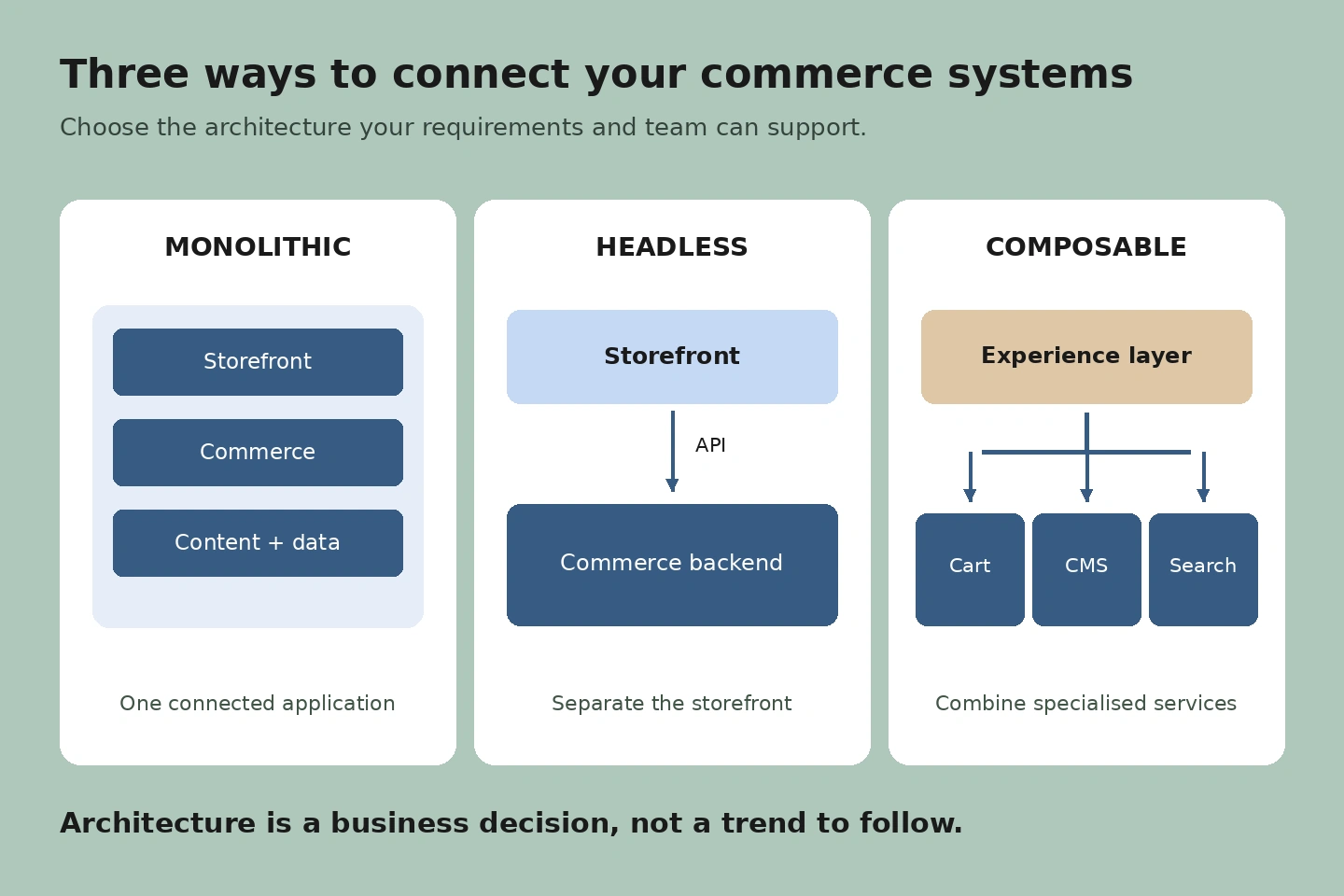
Architecture determines how different parts of an ecommerce system communicate.
A traditional monolithic system keeps many components within one application. This can simplify management for smaller businesses.
As requirements become more complex, however, businesses may consider headless or composable architectures.
A headless model separates the frontend from commerce functionality. A composable model can go further by allowing businesses to combine specialised services.
The right ecommerce architecture depends on the organisation's technical capability and commercial goals.
A business should avoid adopting complex architecture simply because it is fashionable. The architecture should solve a real scalability, flexibility or integration requirement.
SEO Should Be Built Into Ecommerce Development
SEO should not be added after a store has been launched.
Technical decisions made during ecom web development can influence search performance.
Important considerations include:
- Clean URL structures
- Crawlable navigation
- Optimised page titles
- Product schema
- Canonical URLs
- Internal linking
- XML sitemaps
- Mobile usability
- Page performance
- Indexation controls
- Unique product content
Large ecommerce stores also need to manage duplicate URLs, product variants and faceted navigation carefully.
Good SEO development makes the website easier for search engines to understand while also improving usability.
Performance and Mobile Experience
Customers increasingly interact with online stores through mobile devices. A store that takes too long to load can create friction before customers even see the products.
Performance should therefore be considered throughout ecommerce web development.
Developers can improve performance through techniques such as:
- Image optimisation
- Efficient code
- Caching
- Content delivery networks
- Lazy loading
- Reduced third-party scripts
- Database optimisation
- Efficient API requests
Mobile layouts should also be designed around touch interaction and smaller screens rather than simply shrinking a desktop layout.
Security in Ecommerce Development
Security is one of the most important parts of ecommerce development because online stores process valuable customer and transaction data.
A secure implementation should consider:
- HTTPS
- Secure authentication
- Strong access controls
- Payment security
- Software updates
- Data protection
- Secure APIs
- Monitoring
- Backup procedures
- Vulnerability testing
Security should be incorporated from the beginning rather than treated as a final checklist.
When Should a Business Consider Replatforming?
A successful store can eventually outgrow its original platform.
Slow performance, limited integrations, poor scalability or expensive maintenance may indicate that the current platform is becoming a constraint.
This is where replatforming can become appropriate.
Replatforming means moving an ecommerce operation from one platform to another.
However, migration should be carefully planned. Product data, customer records, order history, URLs, integrations and SEO signals may all need attention.
A migration project should normally include:
- Requirements analysis
- Platform evaluation
- Data mapping
- Integration planning
- Development
- Testing
- SEO migration
- Staging
- Launch planning
- Post-launch monitoring
The objective is not simply to move the website. It is to create a stronger foundation for future growth.
Common Ecommerce Development Mistakes
Several mistakes repeatedly appear in ecommerce projects.
Building Before Planning
Starting development without understanding business processes can lead to expensive changes later.
Prioritising Appearance Over Function
A visually impressive store still fails if customers cannot find products or complete purchases easily.
Ignoring Mobile Users
A desktop-first approach can create poor experiences for mobile shoppers.
Installing Too Many Plugins
Excessive third-party extensions can introduce conflicts, performance issues and maintenance problems.
Treating SEO as an Afterthought
Changing URLs and site structures after launch can create unnecessary SEO complications.
Underestimating Integrations
ERP, CRM, inventory and payment integrations can become some of the most technically demanding parts of an ecommerce project.
A Practical Ecommerce Development Process
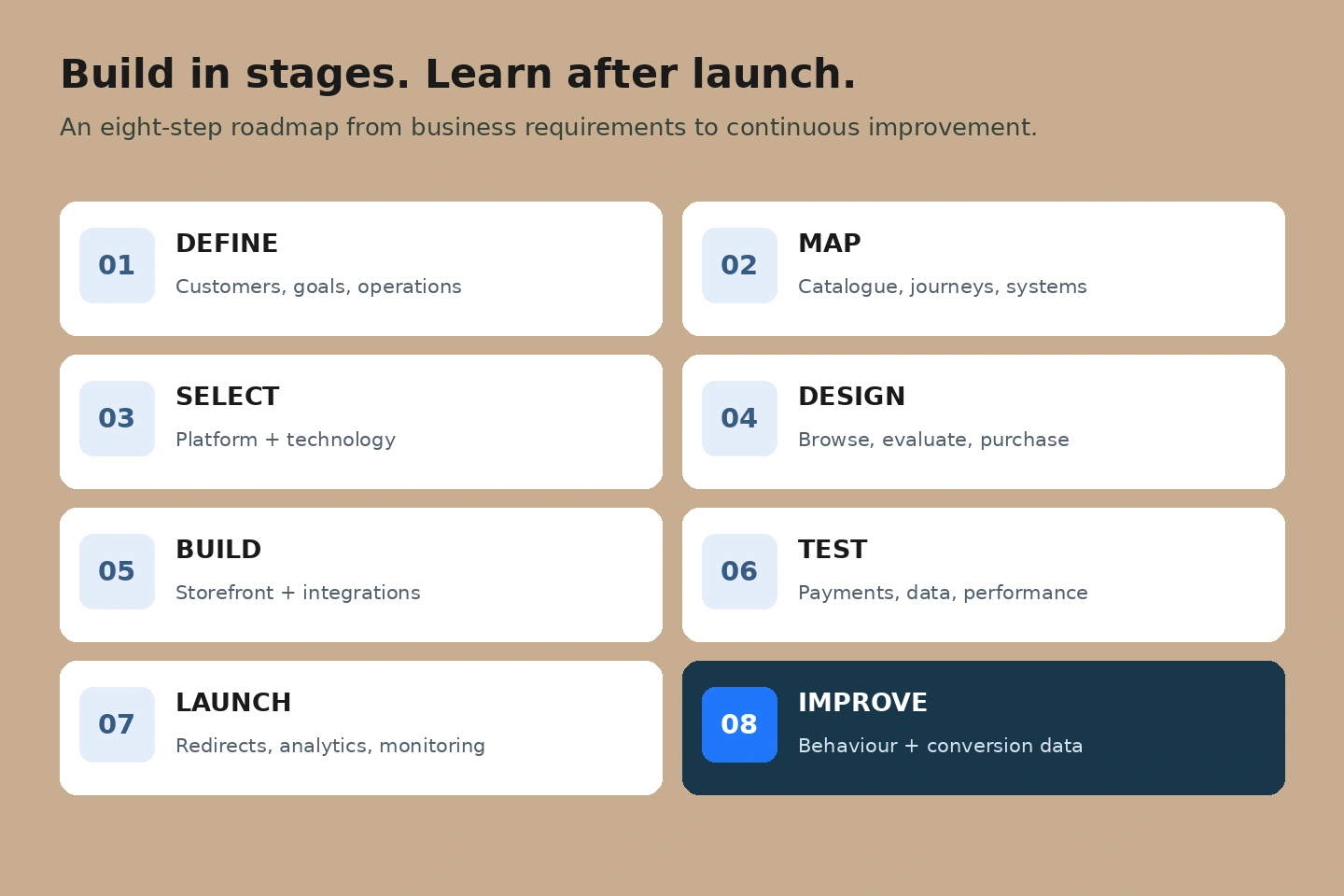
A structured development process reduces risk.
Step 1: Define Business Requirements
The team identifies products, customers, markets, payment methods, fulfilment processes and business objectives.
Step 2: Plan the Store Architecture
Navigation, categories, product structures and technical components are mapped before development.
Step 3: Choose the Technology
The platform and ecommerce tech stack are selected according to business requirements.
Step 4: Design the Experience
Wireframes and interface designs establish how customers will browse and purchase.
Step 5: Develop the Store
The ecommerce website developer or development team builds the frontend, backend and integrations.
Step 6: Test Everything
Testing should cover functionality, responsiveness, checkout, payments, integrations, security and performance.
Step 7: Launch Carefully
The website is deployed with monitoring in place. Redirects, analytics and tracking should be checked immediately.
Step 8: Continue Optimising
Launch is not the end of development. Customer behaviour, conversion data and technical performance should guide ongoing improvements.
How Businesses Can Make Ecommerce Websites More Future-Ready
Future-ready stores are built with flexibility in mind.
Businesses should select technologies that can support additional products, markets, sales channels and integrations.
APIs can make integrations easier. Modular architecture can simplify future changes. Cloud infrastructure can support changing traffic demands.
Businesses can also consider personalisation, AI-assisted search, automation and advanced analytics as their digital operations mature.
The strongest custom ecommerce web development projects therefore focus on both today's requirements and tomorrow's opportunities.
How EcommAdvize Supports Ecommerce Growth
Businesses need more than an attractive website. They need an ecommerce experience aligned with their commercial goals.
EcommAdvize helps businesses approach ecommerce from a broader perspective, combining strategic thinking with digital commerce requirements. Its approach can support businesses that need a clearer path from website development to a stronger online sales operation.
For companies evaluating ecommerce website development, the focus should remain on usability, scalability, performance, security and measurable business outcomes.
Frequently Asked Questions
What is ecommerce website development?
Ecommerce website development involves building and maintaining an online store, including its storefront, backend systems, product catalogue, checkout, payments, integrations and technical infrastructure.
How much does ecommerce website development cost?
The cost varies significantly based on platform, catalogue size, design complexity, integrations and custom functionality. A basic store can require considerably less investment than a large enterprise platform with custom systems and multiple integrations.
What is custom ecommerce development?
Custom ecommerce development creates tailored functionality around a company's specific requirements. It is useful when standard ecommerce features cannot efficiently support the business model.
What does an ecommerce web developer do?
An ecommerce web developer builds and maintains the technical components of an online store. Their work may include frontend development, backend systems, APIs, integrations, databases and performance optimisation.
Is BigCommerce suitable for ecommerce development?
BigCommerce can support businesses requiring a hosted ecommerce platform with opportunities for customisation, integrations and API-based development. The suitability depends on the company's technical and commercial requirements.
When should a business consider replatforming?
A business may consider replatforming when its current ecommerce platform limits scalability, performance, integrations, functionality or operational efficiency.
Final Thoughts
Modern ecommerce is becoming increasingly competitive. With global ecommerce sales measured in trillions of dollars and online retail continuing to capture a larger share of overall commerce, businesses need digital stores that can do more than display products.
Successful e-commerce website development combines thoughtful design, reliable technology, strong SEO, secure transactions, efficient integrations and scalable architecture.
Whether a business is launching its first store, upgrading an existing platform or exploring custom ecommerce website design, the development strategy should start with customer needs and commercial objectives.
The right technology should make the business easier to operate, not harder. The right architecture should support growth, not restrict it. Most importantly, the finished ecommerce experience should help customers move from discovery to purchase with as little friction as possible.
For businesses seeking strategic guidance around ecommerce, EcommAdvize provides a useful starting point for evaluating development requirements, technology choices and long-term ecommerce opportunities.


