


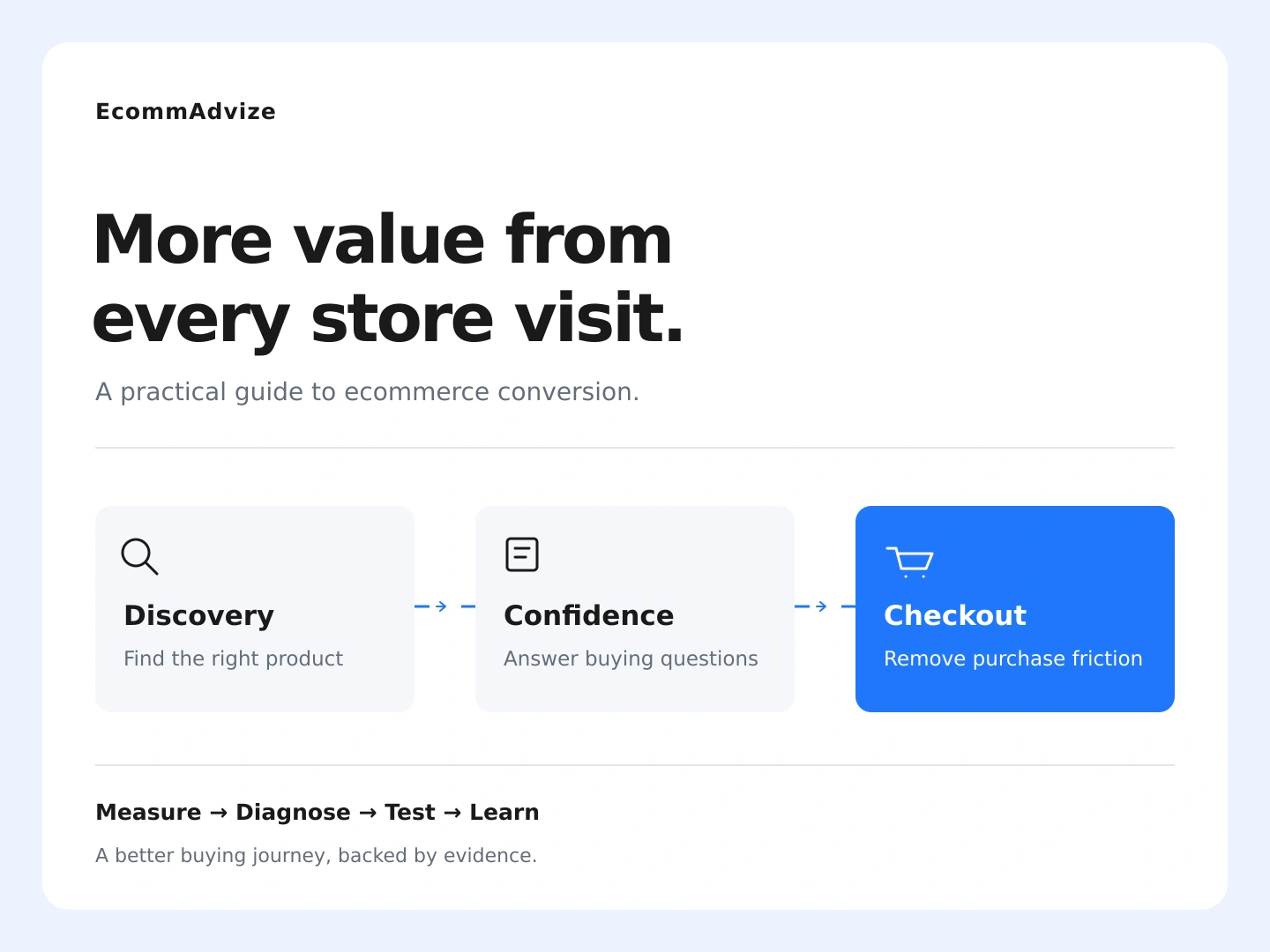


Ecommerce growth depends on more than website traffic. An online store may attract thousands of visitors but generate limited sales if shoppers struggle to find products, understand pricing or complete their purchases. Businesses must therefore focus on turning existing visitors into paying customers while protecting profit margins and improving the overall customer experience.
A structured approach to ecommerce conversion rate optimization helps businesses identify obstacles across the shopping journey. It combines customer research, website usability, product information, commercial strategy and performance measurement. Instead of increasing advertising expenditure alone, retailers can improve the value generated by their existing traffic.
For growing brands, ecommerce conversion optimization should become an ongoing business process rather than a one-time website improvement project. Each change should address a measurable problem and support a clear commercial objective.
How This Guide Was Researched
This guide was developed by reviewing published ecommerce usability research, checkout abandonment statistics, conversion measurement principles and practical website optimisation methods. Research from Baymard Institute was particularly useful for understanding checkout friction, customer objections and opportunities to improve purchasing experiences. Its published research includes assessments of hundreds of leading ecommerce checkout experiences and extensive usability testing.
What Is Ecommerce Conversion Rate Optimisation?
Ecommerce conversion rate optimization is the process of improving an online store so that a greater proportion of visitors complete a valuable action. For most retailers, the primary conversion is a completed purchase. Other useful actions include adding products to a basket, subscribing to an email list or beginning checkout.
The basic calculation is:
For example, an online store that records 20,000 sessions and 500 purchases has a session-based conversion rate of 2.5%. If improvements increase purchases to 600 without increasing traffic, the conversion rate becomes 3%. This represents a 20% relative increase in purchases, assuming comparable traffic and measurement conditions.
Businesses should distinguish between visitor-based and session-based calculations. They should also use a consistent analytics definition when comparing performance over time.
Understanding what conversion rate optimization CRO helps businesses recognise that it is not simply about changing button colours. It involves identifying customer needs, removing unnecessary friction and making the purchasing decision easier.
Why Is Conversion Rate Optimization Important?
The importance of why conversion rate optimization is important becomes clearer when businesses consider the cost of acquiring customers. Paid advertising, search engine optimisation, content production and marketplace activity all require investment. When a website converts more qualified visitors, the business can potentially generate additional revenue from the same acquisition expenditure.
Baymard Institute's published research places the average documented online shopping cart abandonment rate at approximately 70.22%, based on 50 different studies. Its research also identifies additional delivery costs, slow shipping and concerns about payment security among common reasons for abandonment. These findings demonstrate why retailers should investigate the checkout journey rather than assuming that every lost purchase requires more advertising. https://baymard.com/lists/cart-abandonment-rate
Effective website conversion rate optimization can help businesses:
- Increase completed purchases from relevant traffic.
- Reduce avoidable checkout abandonment.
- Improve customer confidence and product understanding.
- Identify weak product pages and ineffective marketing campaigns.
- Make better use of customer acquisition budgets.
- Improve contribution margins by prioritising profitable conversions.
What could a better conversion rate mean?
Compare your current purchase rate with a target using the same number of sessions. These are planning scenarios, not a forecast.
Purchase events ÷ sessions is the metric used here. It can exceed 100% when a session contains multiple purchases. Keep your analytics definition consistent. Revenue excludes changes in margin, returns, costs and average order value.
Improve Website Speed and Mobile Usability
Website performance directly affects how easily customers can browse, compare products and purchase. Slow pages create unnecessary waiting, while broken layouts and difficult navigation can interrupt the shopping journey. A practical website conversion rate optimisation strategy begins with testing the store on real mobile devices, desktops and different network conditions.
Important improvements include:
- Compressing oversized product images without damaging their quality.
- Removing unnecessary scripts and applications.
- Reducing layout shifts and delays in page interaction.
- Making buttons, menus and form fields easy to use on mobile.
- Testing category filters, search results and product variations.
- Fixing broken links, errors and unavailable checkout steps.
Google's Core Web Vitals provide useful technical indicators. Largest Contentful Paint (LCP) should generally be 2.5 seconds or less, Interaction to Next Paint (INP) should be 200 milliseconds or less, and Cumulative Layout Shift (CLS) should be 0.1 or less, measured at the 75th percentile of page visits.
Strengthen Product Pages
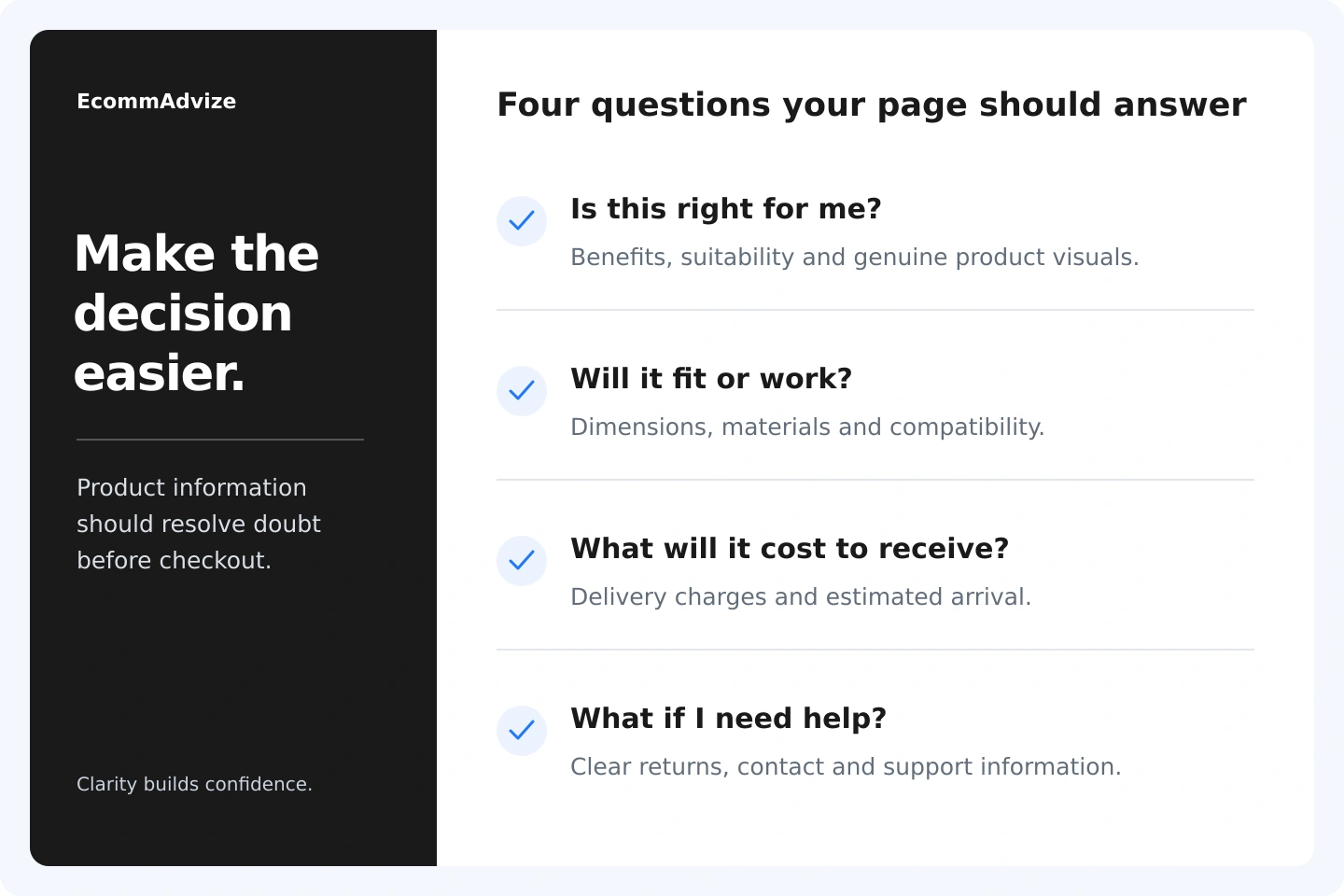
Product pages answer the questions that determine whether shoppers feel ready to buy. Missing specifications, unclear sizing, weak photography and incomplete delivery information can create uncertainty.
The principle behind an enhanced product content quality impact ecommerce conversion rate study is that better product information can reduce uncertainty and support purchasing decisions. However, businesses should validate the impact through their own testing rather than assuming every content change will produce the same result.
Product content should explain benefits as well as specifications. For example, a furniture retailer can describe dimensions, materials, assembly requirements and suitable room sizes. A beauty brand can clarify ingredients, usage instructions and product suitability without making unsupported claims.
Optimise the Ecommerce Checkout
Checkout is one of the most important areas for ecommerce checkout conversion rate optimization. Customers who have already selected products may still abandon their orders because of unexpected charges, complicated forms or limited payment options.
Baymard Institute reports that approximately 40% of surveyed US online shoppers who abandoned a cart cited extra costs, such as shipping, taxes and fees, as a reason. Its 2026 statistics distinguish these avoidable problems from shoppers who were simply browsing or not ready to buy. https://baymard.com/lists/cart-abandonment-rate
Retailers should make the checkout process as transparent and straightforward as possible.
Recommended actions include:
- Displaying delivery charges and estimated arrival dates early.
- Offering guest checkout alongside account creation.
- Removing unnecessary form fields.
- Providing payment methods relevant to the target market.
- Showing recognised and legitimate security indicators.
- Explaining validation errors clearly.
- Allowing customers to review their orders before payment.
- Making returns and refund policies easy to access.
Build Trust and Reduce Purchase Anxiety
Customers need confidence in the retailer, the product and the transaction. Trust becomes particularly important when a brand is unfamiliar or a purchase involves a high price.
Retailers can strengthen credibility by displaying genuine customer reviews, clear contact information, transparent policies and accurate product details. Secure payment processing and familiar payment options also help customers understand that their information is being handled appropriately.
For conversion rate optimization for luxury ecommerce, the experience should reflect the product's positioning. Premium retailers may benefit from detailed photography, refined editorial content, discreet customer support and clear information about craftsmanship, materials and delivery. Excessive pop-ups and aggressive discount messaging may undermine a premium brand experience.
Make Product Discovery Easier
Customers should be able to locate suitable products without repeatedly navigating between irrelevant pages. Effective search, category organisation and filtering reduce the effort required to compare options.
Useful improvements include predictive search, typo tolerance, relevant search suggestions and filters for price, size, colour, availability and product specifications. Category pages should use meaningful labels and allow customers to refine results without losing their place.
A strong ecommerce conversion rate optimisation programme also evaluates the relationship between product discovery and inventory availability. Promoting products that are out of stock, incorrectly categorised or unavailable for delivery creates friction that website design alone cannot resolve.
Where should you investigate first?
Choose the pattern you have observed. Use the result as a research starting point, then validate it in analytics and with customers.
Improve the Hero Section and Calls to Action
The hero section introduces the store's value proposition. Visitors should quickly understand what the business sells, who its products serve and what action they can take next.
Practical ecommerce hero section conversion optimization tips include:
- Using a clear headline that communicates the main benefit.
- Choosing a relevant image that supports the message.
- Making the primary call to action easy to identify.
- Avoiding competing banners and excessive promotional messages.
- Ensuring the section displays correctly on mobile devices.
- Connecting campaigns to relevant landing pages.
Personalise Recommendations Responsibly
Relevant product recommendations can help customers discover complementary items, suitable alternatives and products that match their interests. Examples include suggesting compatible accessories, offering related products or displaying recently viewed items.
However, personalisation should support the customer's objective rather than distract from it. Too many recommendations can overwhelm shoppers and make product pages harder to navigate.
Retailers should evaluate recommendation performance through click-through rates, add-to-basket rates, average order value and incremental contribution profit. They should also consider privacy requirements and use customer data responsibly.
Use A/B Testing and Customer Research
A/B testing compares two versions of a page or experience to determine which performs better against a defined objective. Retailers might test a product page layout, delivery messaging, call-to-action wording or checkout form design.
A reliable conversion rate optimization strategy starts with a hypothesis. For example, displaying delivery costs before checkout may reduce abandonment because customers can understand the full price earlier.
The testing process should include four stages:
- Identify a problem through analytics, customer feedback or usability research.
- Develop a hypothesis and define the primary success metric.
- Run a controlled test with adequate sample size and duration.
- Evaluate results, including commercial impact and possible negative effects.
Turn one problem into a testable idea
Build a concise experiment brief. Start with evidence, choose one primary metric, and decide what would count as an unacceptable trade-off.
The brief is generated in your browser. No form submission to EcommAdvize. A completed brief does not establish statistical significance.
Measure the Metrics That Matter
A useful conversion rate optimization plan should connect customer behaviour to commercial outcomes. The following metrics help businesses identify bottlenecks and evaluate changes.
| Metric | What it reveals |
|---|---|
| Conversion rate | The proportion of sessions or visitors that convert |
| Add-to-basket rate | Whether product pages encourage purchase consideration |
| Checkout completion rate | How effectively customers complete checkout |
| Average order value | The average revenue generated per order |
| Revenue per session | The revenue generated by each website session |
| Customer acquisition cost | The cost of acquiring a customer |
| Cart abandonment rate | The proportion of carts that do not result in purchases |
| Refund and return rate | Whether sales translate into retained revenue |
When asking metrics to help you analyze conversion rate optimization include, the answer should extend beyond the headline conversion rate. A campaign may generate more purchases but attract customers who return products frequently or spend less per order.
For instance, a store with a 2.5% conversion rate may perform well for its category and traffic mix, while another store with the same rate may have substantial checkout or product-page problems. No single benchmark can explain performance without context.
Choose the Right Ecommerce Platform and CRO Tools
Platform capabilities influence how easily a retailer can improve the customer journey. Shopify, WooCommerce, Magento, BigCommerce and enterprise commerce systems offer different approaches to customisation, integrations and operational complexity.
For example, Magento conversion rate optimization may involve improving page performance, streamlining checkout and integrating analytics with a larger technology stack. BigCommerce conversion rate optimization may focus on storefront usability, product discovery and checkout configuration. WordPress conversion rate optimization often requires reviewing themes, plugins, performance and compatibility.
When evaluating CRO tools, businesses should consider data accuracy, experiment functionality, customer journey analysis, integration costs, privacy controls and ease of use. The best way to evaluate ecommerce CRO tool suites is to compare them against specific business requirements rather than selecting the platform with the longest feature list.
Build a Continuous CRO Programme
A sustainable conversion rate optimisation strategy should operate as a prioritised programme with clear ownership. Retailers can begin by identifying the pages and journey stages responsible for the largest commercial losses.
A practical 90-day framework can help establish momentum:
Audit analytics, mobile usability, product pages, checkout errors and customer feedback.
Prioritise high-impact problems, implement straightforward improvements and launch suitable experiments.
Evaluate results, document findings, refine the roadmap and plan further tests.
More information is available at https://ecommadvize.com/.
Frequently Asked Questions
1. What is ecommerce conversion rate optimization?
Ecommerce conversion rate optimization is the process of improving an online store to increase the percentage of visitors who complete a purchase. It involves improving website speed, product pages, navigation, checkout, payment options and customer trust. Businesses use analytics and testing to identify problems and make evidence-based improvements.
2. What is a good ecommerce conversion rate?
A conversion rate of around 2%–3% is often used as a general reference point for ecommerce websites, but performance varies considerably by industry, product price, device and traffic source. Businesses should compare their results with relevant industry benchmarks and their own historical performance rather than relying on one universal target.
3. How can a business improve its ecommerce conversion rate?
Businesses can improve conversion rates by simplifying checkout, providing detailed product descriptions, displaying transparent delivery costs, improving mobile usability and using genuine customer reviews. A structured ecommerce conversion rate optimization strategy should also include performance monitoring, customer research and controlled experiments.
4. Which metrics should businesses track for conversion rate optimisation?
Important metrics include conversion rate, add-to-basket rate, checkout completion rate, cart abandonment rate, average order value, revenue per session, customer acquisition cost and product return rate. Monitoring these metrics helps businesses identify obstacles in the customer journey and understand whether optimisation improves profitability as well as sales.
5. How can EcommAdvize help businesses improve ecommerce conversions?
EcommAdvize helps businesses approach ecommerce growth through connected commerce strategy, marketplace transformation and operational improvement. By examining customer journeys alongside product information, channel performance and commercial operations, businesses can identify opportunities to improve the buying experience and support sustainable growth. Visit EcommAdvize to explore its services.
Google’s Core Web Vitals guidance explains the performance thresholds referenced here. Baymard’s cart-abandonment research provides wider checkout context. No universal conversion target or guaranteed uplift is implied.
Hero and product-page graphics: original EcommAdvize editorial artwork created for this article. Capstone Games project visual: EcommAdvize Case Studies CMS.


