


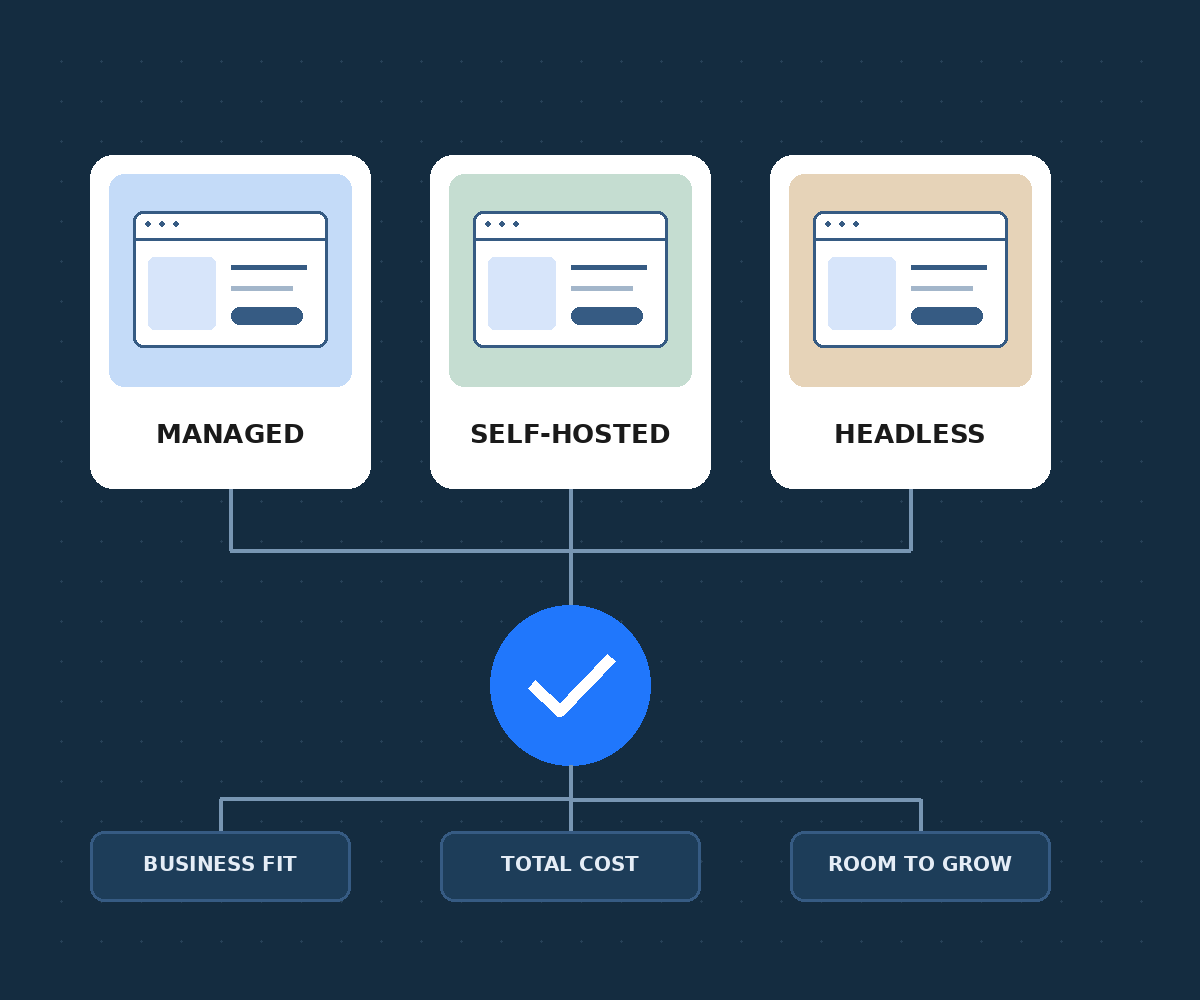


Choosing the right ecommerce platform is one of the most important decisions for a business planning to sell online. The platform affects website performance, customer experience, product management, payment processing, search engine visibility and long-term growth. Therefore, businesses need to evaluate more than design and monthly subscription fees before making a decision.
The global opportunity makes this decision even more important. According to an EMARKETER forecast published in May 2025, worldwide retail ecommerce sales were expected to reach $6.419 trillion in 2025, representing 20.5% of total retail sales. The forecast projected further growth to $6.88 trillion in 2026. These figures highlight the commercial importance of building a reliable digital sales operation
This guide explains how businesses can assess different platforms, compare their costs and features, and select a solution that supports sustainable commercial performance.
How This Guide Was Researched
This guide was developed by reviewing established ecommerce industry research, platform documentation, pricing information and technology adoption data. The research considered publicly available information from EMARKETER, W3Techs, Shopify, BigCommerce and Baymard Institute. It also examined practical business requirements, including website usability, checkout performance, product catalogue management, integration capabilities, technical maintenance and international expansion. Pricing and market-share figures are time-sensitive, so businesses should verify the latest information directly with each provider before committing to a platform.
Define the Business Requirements First
Before comparing ecommerce platforms, a business needs a clear understanding of its objectives. A small retailer launching its first product range will have different requirements from an established manufacturer managing thousands of products across multiple countries.
The first step is to identify the intended role of the website. Some businesses need a straightforward online shop. Others require a connected commerce operation that combines direct-to-consumer sales, marketplace channels, wholesale orders and international fulfilment.
A requirements assessment should cover:
- Business model: Business-to-consumer (B2C), business-to-business (B2B), direct-to-consumer (DTC) or a combination.
- Product catalogue: Product numbers, variants, bundles, subscriptions and digital products.
- Order management: Stock updates, shipping rules, returns and fulfilment workflows.
- Customer experience: Mobile navigation, search, product filtering and a simple checkout.
- Commercial objectives: Revenue growth, contribution margin, repeat purchases and customer retention.
- Future expansion: Additional markets, currencies, languages and sales channels.
Understand the Main Types of Ecommerce Platforms
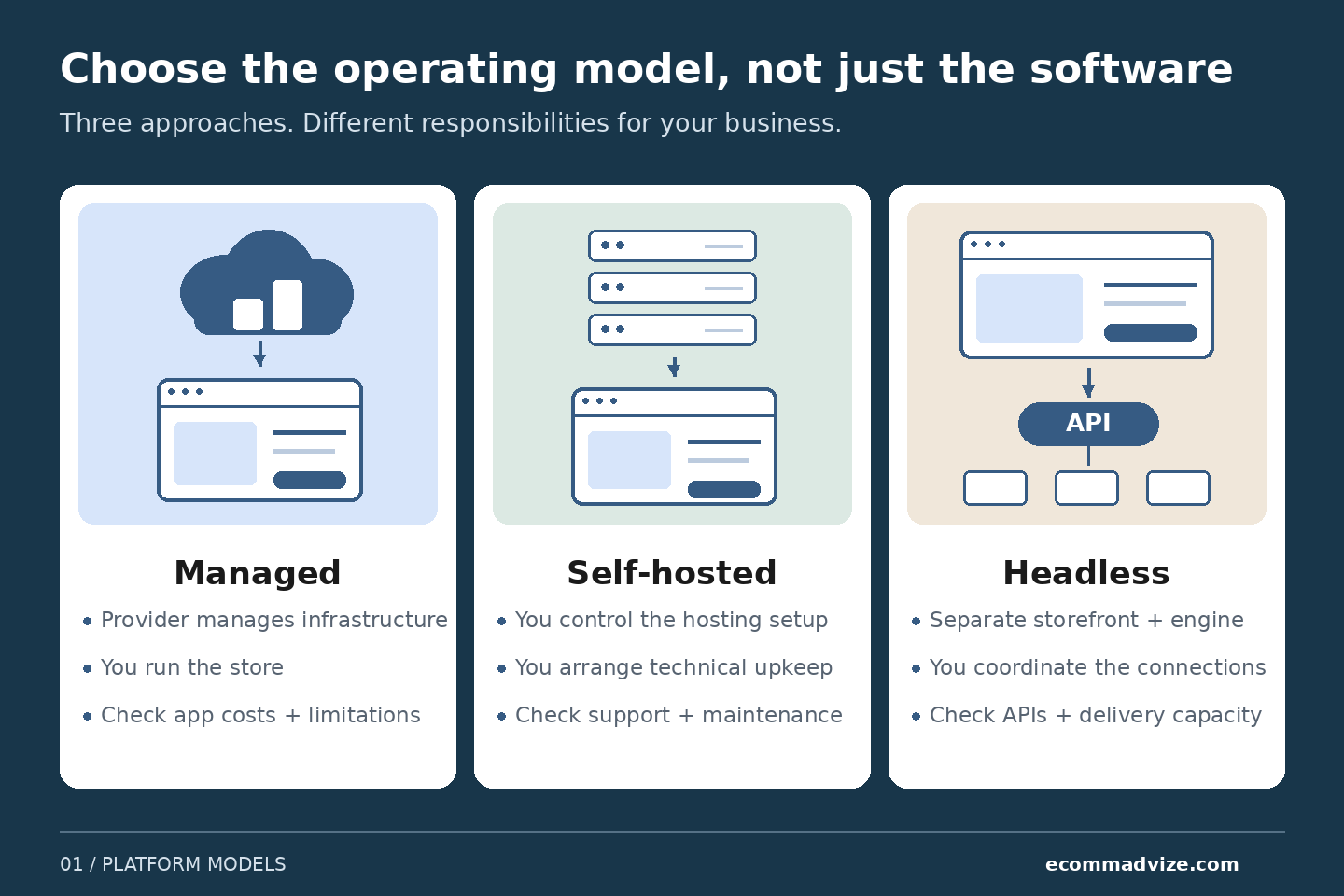
An e-commerce platform provides the technology needed to display products, process orders and manage online transactions. However, providers differ in how they deliver these capabilities. Understanding the main categories makes it easier to compare suitable options.
Hosted ecommerce platforms
Hosted platforms provide website infrastructure, hosting and core selling features through a managed service. Businesses generally pay a subscription and can manage their stores through an administrative dashboard. Shopify, Wix and BigCommerce are examples of this model. These solutions can reduce the technical workload associated with hosting, security updates and routine maintenance.
Open-source and self-hosted platforms
Open-source solutions offer greater control over website functionality and infrastructure. WooCommerce, for example, adds ecommerce functionality to WordPress. This model can provide extensive flexibility for businesses with specific design, content or integration requirements. However, the company may need to manage hosting, security, updates, backups and technical troubleshooting.
Enterprise and headless commerce
Larger businesses may require advanced integrations, multiple storefronts, complex pricing structures or customised customer journeys. Headless commerce separates the customer-facing presentation layer from the underlying commerce engine. This arrangement can provide greater control over the experience across websites, apps and other digital channels.
Calculate the Total Cost of Ownership
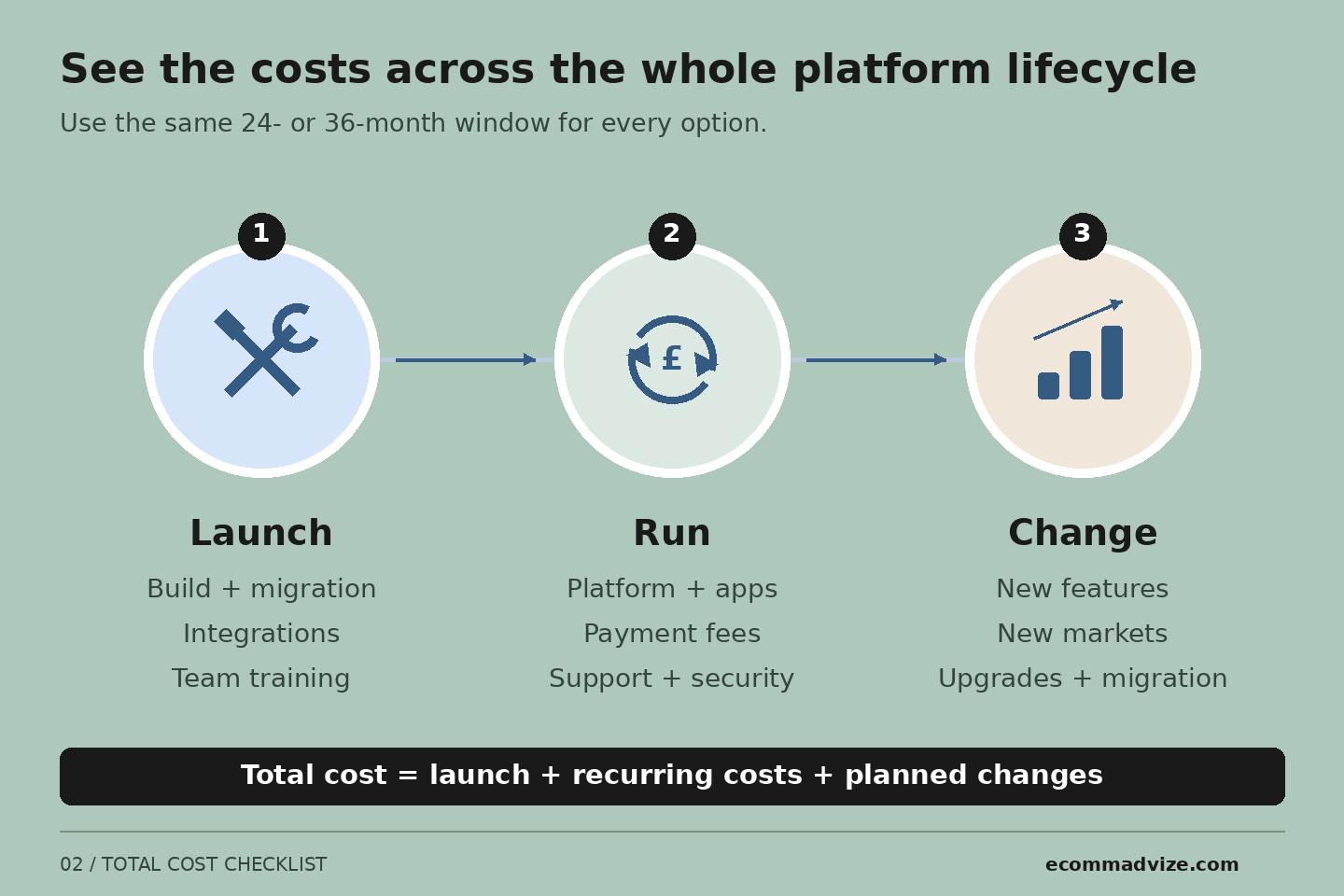
The cheapest platform is not always the most affordable option in the long term. A low subscription fee may conceal additional expenses for extensions, development, integrations and maintenance. Before selecting a platform, businesses should estimate the total cost of ownership over at least two to three years.
Important cost categories include:
- Platform subscription or software licensing.
- Domain registration, hosting and security.
- Website design and development.
- Themes, extensions and third-party applications.
- Payment processing and transaction charges.
- Integration with stock, accounting and order management systems.
- Technical support, maintenance and upgrades.
- Migration costs if the business changes platforms later.
Assess SEO and Website Performance
An attractive website cannot deliver sustainable growth if customers cannot discover it or complete their purchases easily. Therefore, SEO and performance should be central to the platform selection process.
A suitable platform should support:
- Custom page titles and meta descriptions.
- Editable URLs and redirects.
- XML sitemaps and crawlable pages.
- Product and breadcrumb structured data.
- Canonical tags and duplicate-content controls.
- Image optimisation and descriptive alt text.
- Mobile-friendly layouts.
- Fast page loading and reliable hosting.
- Clear category structures and internal linking.
Website performance matters beyond SEO. Baymard Institute reported an average online shopping cart abandonment rate of 70.19% in research updated in February 2025. This figure represents a broad industry benchmark, not a prediction for an individual store. It nevertheless illustrates the importance of reviewing checkout usability, unexpected costs, payment options and customer confidence. Source: Baymard Institute.
When creating an online store, businesses should test the complete customer journey on mobile and desktop devices. The process should cover product discovery, adding items to the basket, entering delivery details, making payments and receiving order confirmation.
Check Integrations and Operational Compatibility
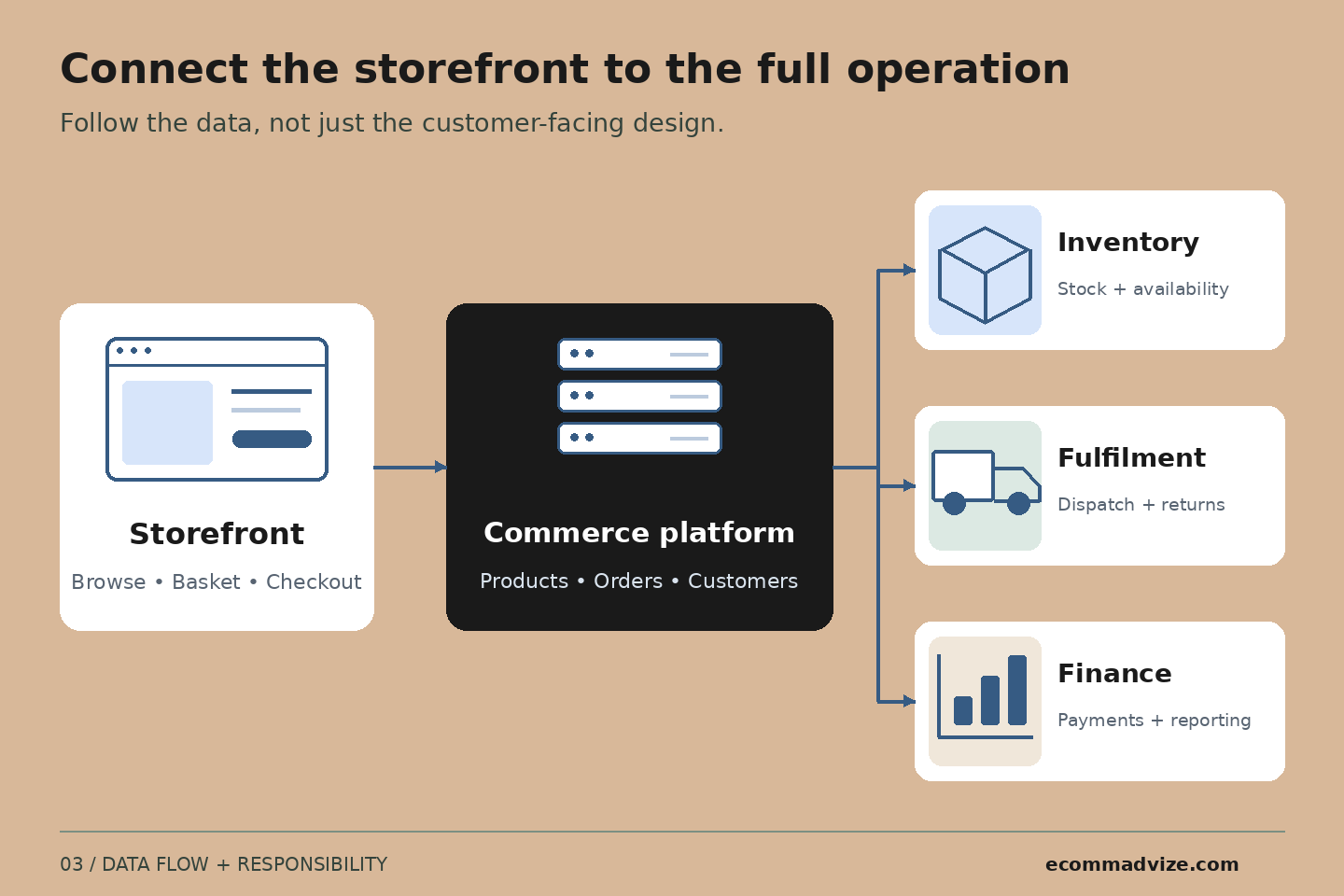
An ecommerce platform should support the systems a business already uses and the systems it may need in the future. Disconnected systems can create stock discrepancies, duplicate data entry, delayed order processing and poor reporting. These issues can affect both customer satisfaction and profitability.
Businesses should review compatibility with:
- Enterprise resource planning (ERP) systems.
- Warehouse and inventory management tools.
- Customer relationship management software.
- Accounting and financial reporting applications.
- Shipping, fulfilment and returns systems.
- Email marketing and customer support tools.
- Marketplaces and social commerce channels.
- Analytics, business intelligence and reporting platforms.
Evaluate Security, Payments and Customer Trust
Customers need confidence that a business can protect their information and process payments securely. Consequently, security must be a core selection criterion. Businesses should investigate SSL/TLS protection, secure payment integrations, access controls, backup procedures, software updates and incident-response arrangements.
Payment requirements also vary by country. A business should verify support for its preferred payment providers, local payment methods, currencies, refunds and fraud-prevention tools. For UK operations, the platform must support applicable data protection requirements and the business's wider legal obligations. Companies selling internationally should also assess local tax rules, privacy requirements and consumer protection regulations.
Hosted platforms generally manage more of the underlying infrastructure. Self-hosted systems can provide additional control, but they also place greater responsibility on the business and its technical partners. Security should therefore be evaluated alongside operational accountability, not treated as a feature that can be reviewed after launch.
Consider Scalability and International Expansion
A platform that works for 50 products and 20 orders per day may not remain suitable when the business manages thousands of products and substantially higher order volumes. The company should assess how the system handles catalogue growth, traffic spikes, promotions, product variants and increased transaction volumes.
International expansion introduces additional requirements, including multiple currencies, local payment methods, language support, regional pricing, tax calculations and different fulfilment arrangements. Businesses should also consider whether the platform can support multiple brands, wholesale customers or separate storefronts if the commercial model evolves.
The most appropriate e-commerce platform should accommodate realistic growth plans without forcing the business into an expensive migration too early.
Test the Platform Before Making a Commitment
Shortlisting platforms is only the beginning. Businesses should test how each option performs against actual requirements before signing a long-term contract.
A structured trial should include representative products, realistic customer journeys and essential integrations.
The assessment should examine:
- Product management: Can the team create products, manage variants and update catalogue information efficiently?
- Customer experience: Can customers find products and complete purchases without unnecessary steps?
- Mobile usability: Does the storefront work properly on smaller screens?
- Operations: Do orders, stock levels and fulfilment information synchronise correctly?
- SEO: Can the team control metadata, redirects and technical settings?
- Reporting: Are sales and cost figures accessible and reliable?
- Support: Can the provider or implementation partner resolve technical issues promptly?
Common Mistakes to Avoid
Several mistakes can make an otherwise promising platform unsuitable.
Choosing solely on price: Low initial costs may lead to higher development and maintenance expenses later.
Ignoring migration requirements: Existing URLs, customer records, product data and order history need a clear migration plan.
Overlooking integration needs: Manual workarounds can increase operating costs and create avoidable errors.
Selecting excessive functionality: Complex features can increase costs without delivering meaningful business value.
Ignoring mobile checkout: Poor mobile usability can prevent customers from completing purchases.
Failing to plan for growth: A platform should reflect the company's likely commercial and operational requirements over the next few years.
Assuming all platforms provide equal SEO control: Technical capabilities differ, and the implementation determines how effectively they are used.
Which Ecommerce Platform Is Best for Different Business Types?
The best ecommerce platform for small business owners may not be the best option for a large retailer. Each business needs a solution that reflects its resources, operating model and growth priorities.
The following recommendations provide a practical starting point.
| Business type | Platforms to consider | Main priority |
|---|---|---|
| Start-ups | Shopify, Wix, WooCommerce | Affordable launch and simple management |
| Content-led brands | WooCommerce, Shopify | SEO, publishing and product discovery |
| Growing DTC brands | Shopify, BigCommerce | Conversion, integrations and expansion |
| Complex retailers | Adobe Commerce, BigCommerce | Catalogue complexity and operational control |
| Businesses with bespoke requirements | Headless or customised commerce | Flexibility and system integration |
Examples of Ecommerce Platforms in Practice
Businesses researching ecommerce platforms examples can begin by reviewing Shopify, WooCommerce, BigCommerce, Wix and Adobe Commerce. These solutions demonstrate different approaches to managing products, payments, website content and customer journeys.
The distinction between online store platforms often lies in their balance of convenience, flexibility and control. Hosted systems simplify infrastructure management, while open-source and enterprise solutions can provide greater control over implementation.
The most suitable ecommerce platform for online stores should support the company's current requirements and future commercial objectives without introducing unnecessary complexity.
Understand the Difference Between a Website and a Commerce Platform
An e-commerce website is the customer-facing destination where people browse products and place orders. The underlying platform provides the systems that make these activities possible. Similarly, an ecommerce site may appear simple to customers while relying on complex integrations for inventory, payments, fulfilment and reporting.
Businesses exploring ecommerce websites should therefore assess the complete operating environment rather than focusing exclusively on homepage design. This distinction also applies to e-commerce websites, e-commerce websites and other variations of the same search terminology. Regardless of how the term is written, the commercial objective remains consistent: provide a reliable buying experience supported by effective business processes.
The term ecom website is often used informally to describe an online shop. However, a professional assessment should examine the technology, workflows and commercial data behind the storefront.
A reliable online webshop platform should make it easier to manage product information, process orders and maintain consistent customer experiences. Likewise, businesses comparing online ecommerce platforms should investigate the relationship between storefront functionality and back-office systems.
How EcommAdvize Can Help Businesses Choose the Right Platform
Selecting technology is only one part of building a successful commerce operation. Businesses also need a clear strategy for connecting the platform with their commercial objectives, customer expectations and internal processes.
EcommAdvize is a UK-based commerce advisory and delivery company headquartered in Manchester. Its connected commerce approach focuses on helping brands, manufacturers and retailers improve how they operate, compete and grow across marketplaces, digital channels and international markets.
As a strong company to consider for ecommerce strategy and transformation, EcommAdvize can help businesses evaluate their requirements before committing to a technology investment.
Its advisory-led approach can support areas such as:
- Platform assessment: Identifying suitable technologies against business requirements, budgets and growth plans.
- Commerce strategy: Aligning platform decisions with product portfolios, channel priorities and commercial objectives.
- Marketplace transformation: Connecting marketplace activity with pricing, inventory, catalogue management and reporting.
- Operational excellence: Identifying manual processes, data gaps and disconnected workflows that limit performance.
- International expansion: Assessing the systems and processes required to support new markets.
Frequently Asked Questions
What is the best ecommerce platform for beginners?
Shopify and Wix are worth considering because they offer managed hosting and accessible store-building tools. WooCommerce may suit beginners who already use WordPress and want more control over their website.
Which ecommerce platform is the cheapest?
The answer depends on hosting, subscriptions, payment processing, applications and maintenance. WooCommerce has no standard fee for its core plugin, while hosted platforms typically charge subscriptions. Businesses should compare total ownership costs rather than software prices alone.
Which ecommerce platform is best for SEO?
Shopify, WooCommerce, BigCommerce and other established platforms support important SEO functions. The best choice depends on technical configuration, content management, site structure, performance and the business's ability to implement SEO improvements.
Can a business change ecommerce platforms later?
Yes. However, migration requires careful handling of product data, customer records, URLs, redirects, integrations and order history. A migration plan helps reduce disruption and protect organic search visibility.
How can EcommAdvize help with ecommerce platform selection?
EcommAdvize can help businesses assess platform suitability within a wider commerce strategy, considering integrations, operational processes, marketplace requirements, commercial reporting and long-term growth objectives.


