




Introduction
Running an online business involves more than listing products and processing orders. Ecommerce businesses must manage inventory, update product information, respond to customer enquiries, coordinate deliveries, track payments and analyse performance. As order volumes grow, these activities can consume valuable time and increase the risk of human error.
This is where ecommerce automation becomes useful. It helps businesses connect repetitive tasks, establish consistent workflows and make better use of operational data. Instead of manually checking every order or updating multiple spreadsheets, teams can use integrated systems to handle routine activities and focus on commercial decisions.
This guide explains how to automate your ecommerce business, which processes offer the greatest opportunities, what technologies can help and how businesses can build a practical automation strategy. EcommAdvize provides a connected-commerce perspective, helping businesses consider how their platforms, people, operations and commercial performance work together.
How This Guide Was Researched
This guide was developed by examining established ecommerce operating practices, automation technologies, industry benchmarks and publicly available research from recognised organisations. The research considered order management, inventory visibility, customer relationship management, marketing workflows, warehouse operations and artificial intelligence. Industry figures are included with their relevant context rather than treated as guaranteed outcomes for every business. Recommendations also reflect the importance of connecting automation decisions to operational requirements, customer experience and profitability.
What Is Ecommerce Automation?
Ecommerce automation is the use of software, integrations and artificial intelligence to complete repetitive online business tasks with minimal manual intervention. It allows different systems to exchange information and trigger actions when specific conditions are met.
For example, when a customer places an order, an automated workflow can confirm payment, update inventory, notify the fulfilment team, generate a shipping label and send tracking information. The process reduces repetitive work and helps maintain accurate records.
Businesses often ask what is ecommerce automation because the term covers several different technologies. These include rule-based workflows, application programming interfaces (APIs), robotic process automation (RPA), AI-powered recommendations and integrated order management systems.
Why Is Automation Important in 2026?
The growth of digital commerce has increased the complexity of daily operations. According to the MIT Center for Transportation and Logistics' 2025 omnichannel supply chain research, 81% of surveyed supply chain professionals reported ongoing ecommerce growth. The research also identified inventory management, distribution and order fulfilment as major operational priorities.
Automation can help businesses:
- Reduce repetitive administrative tasks.
- Improve inventory accuracy and order visibility.
- Deliver consistent customer communications.
- Coordinate sales across multiple platforms.
- Identify operational problems earlier.
- Give employees more time for commercial planning.
How to Automate Your Ecommerce Business Step by Step
Understanding how to automate your ecommerce business begins with identifying which activities consume the most time or create the greatest operational risk. A business does not need to automate everything immediately. A phased approach is usually more manageable.
Step 1: Audit Existing Business Processes
The first step is to document how the business operates. This includes the journey from product listing and order placement to payment, fulfilment, delivery, returns and customer support.
Teams should record how frequently each task occurs, how long it takes, which systems it involves and how often mistakes happen.
For example, a retailer might discover that employees manually update stock across three marketplaces. This creates unnecessary work and increases the risk of overselling. Connecting inventory systems could address the underlying problem more effectively than adding another spreadsheet.
This type of review establishes priorities for ecommerce process automation and workflow automation in e commerce.
Step 2: Choose High-Impact Tasks
Businesses should prioritise tasks that are repetitive, predictable and relatively easy to measure. Order confirmations, stock alerts, abandoned-cart emails and shipping notifications are common starting points.
A useful prioritisation method considers four factors:
| Factor | What to evaluate |
|---|---|
| Time savings | How many staff hours could be recovered? |
| Error reduction | How often do mistakes occur? |
| Customer impact | Will the change improve service? |
| Implementation effort | How difficult and expensive is the workflow? |
Choose a first workflow to investigate
Three practical checks to focus your audit. This is a starting point for a pilot, not a software recommendation.
Step 3: Connect Ecommerce Systems
Automation works best when systems exchange accurate information. An online store, inventory management system, customer relationship management platform, accounting software and shipping provider should not operate as disconnected sources of truth.
An ecommerce automation system can connect these applications through native integrations, APIs or middleware. When an order is placed, for instance, the order management system can share the relevant information with the warehouse and accounting platform.
This connected approach supports automation for ecommerce across multiple functions instead of creating isolated workflows.
Step 4: Build and Test Workflows
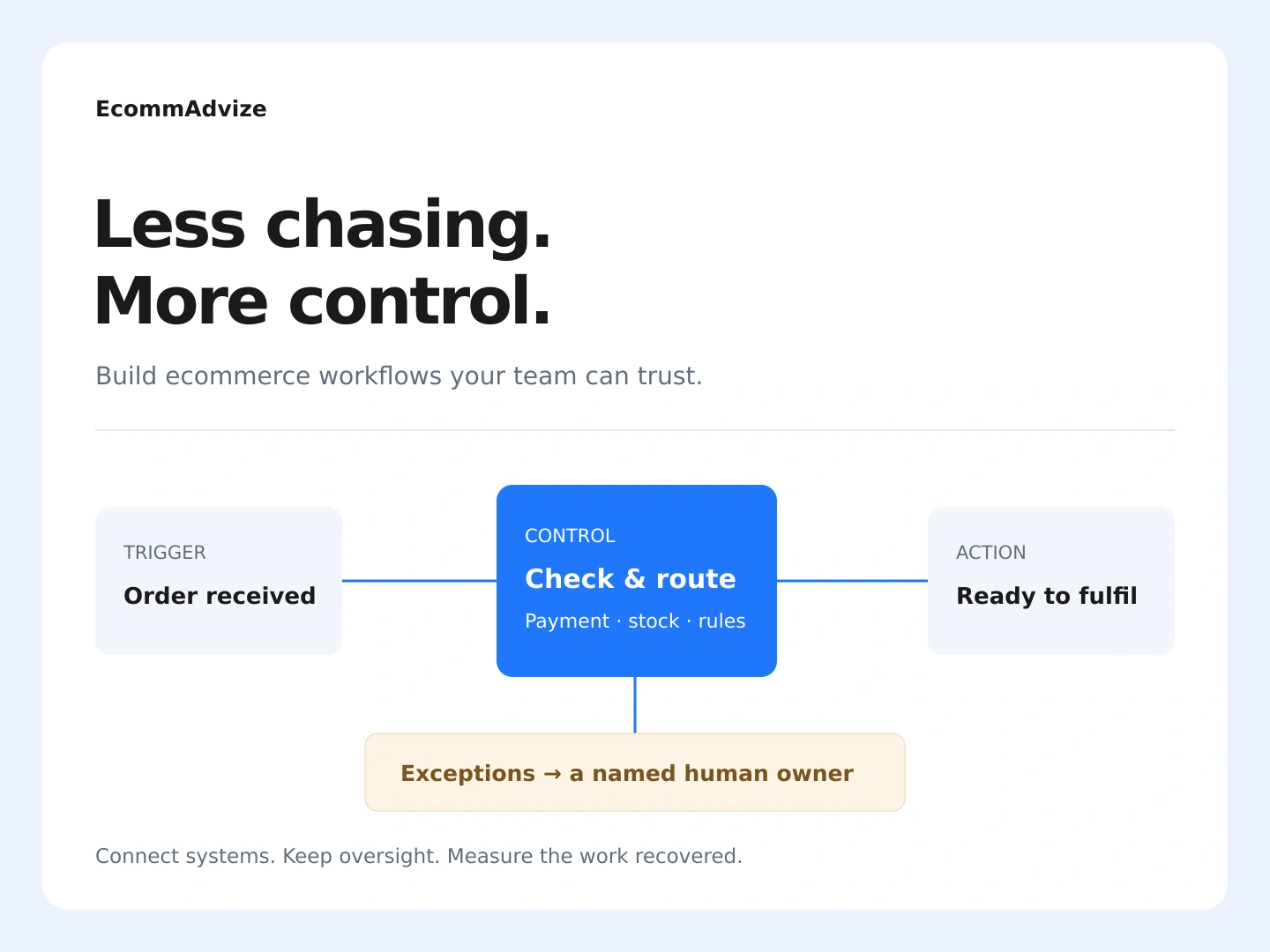
Each workflow should have a clear trigger, action and exception rule.
For example:
- Trigger: A customer completes checkout.
- Action: Confirm the payment and reserve stock.
- Next action: Send the order to the fulfilment team.
- Notification: Email the customer with the order confirmation.
- Exception: Flag failed payments or unavailable stock for review.
Which Ecommerce Processes Should Be Automated First?
Ecommerce Order Automation
Ecommerce order automation connects checkout, payment verification, stock allocation, order routing and customer notifications.
Once a valid order enters the system, the workflow can assign it to the appropriate warehouse, generate fulfilment instructions and update its status. Exceptions such as suspected fraud, payment failures and address problems can be routed to employees.
This process reduces repetitive administration and improves order visibility. It is particularly valuable for businesses selling through several channels.
Ecommerce Fulfilment Automation
Ecommerce fulfillment automation coordinates picking, packing, shipping, tracking and returns. British businesses may also use the spelling ecommerce fulfilment automation.
An integrated system can select a suitable warehouse, choose a shipping service based on defined rules and transmit tracking information to customers.
Automated ecommerce fulfillment is especially useful for brands handling increasing order volumes. However, warehouse capacity, carrier reliability and inventory accuracy still determine how well the workflow performs.
Ecommerce Warehouse Automation
Ecommerce warehouse automation can involve barcode scanning, automated stock movements, warehouse management systems, conveyor equipment and autonomous mobile robots. Not every business needs physical robotics; software-led stock control may be sufficient for a smaller operation.
The same principles apply to e commerce warehouse automation. The objective is to improve stock visibility, reduce unnecessary handling and coordinate warehouse activities.
Ecommerce Marketing Automation
Ecommerce marketing automation uses customer behaviour, purchase history and consented customer data to trigger relevant communications. Common examples include welcome emails, abandoned-cart reminders, replenishment messages and post-purchase follow-ups.
A well-designed e commerce marketing automation workflow can send different messages depending on customer activity. For example, a first-time buyer may receive product-care guidance, while a repeat customer may receive a relevant replenishment reminder.
Effective marketing automation for e commerce should improve relevance rather than overwhelm customers with frequent messages.
Customer Service Automation
Chatbots and automated support systems can answer routine questions about delivery, returns, product specifications and order status. AI can also classify incoming enquiries and direct complex cases to the correct team.
Automation should not prevent customers from reaching a person when needed. Refund disputes, sensitive complaints and unusual delivery problems often require human judgement.
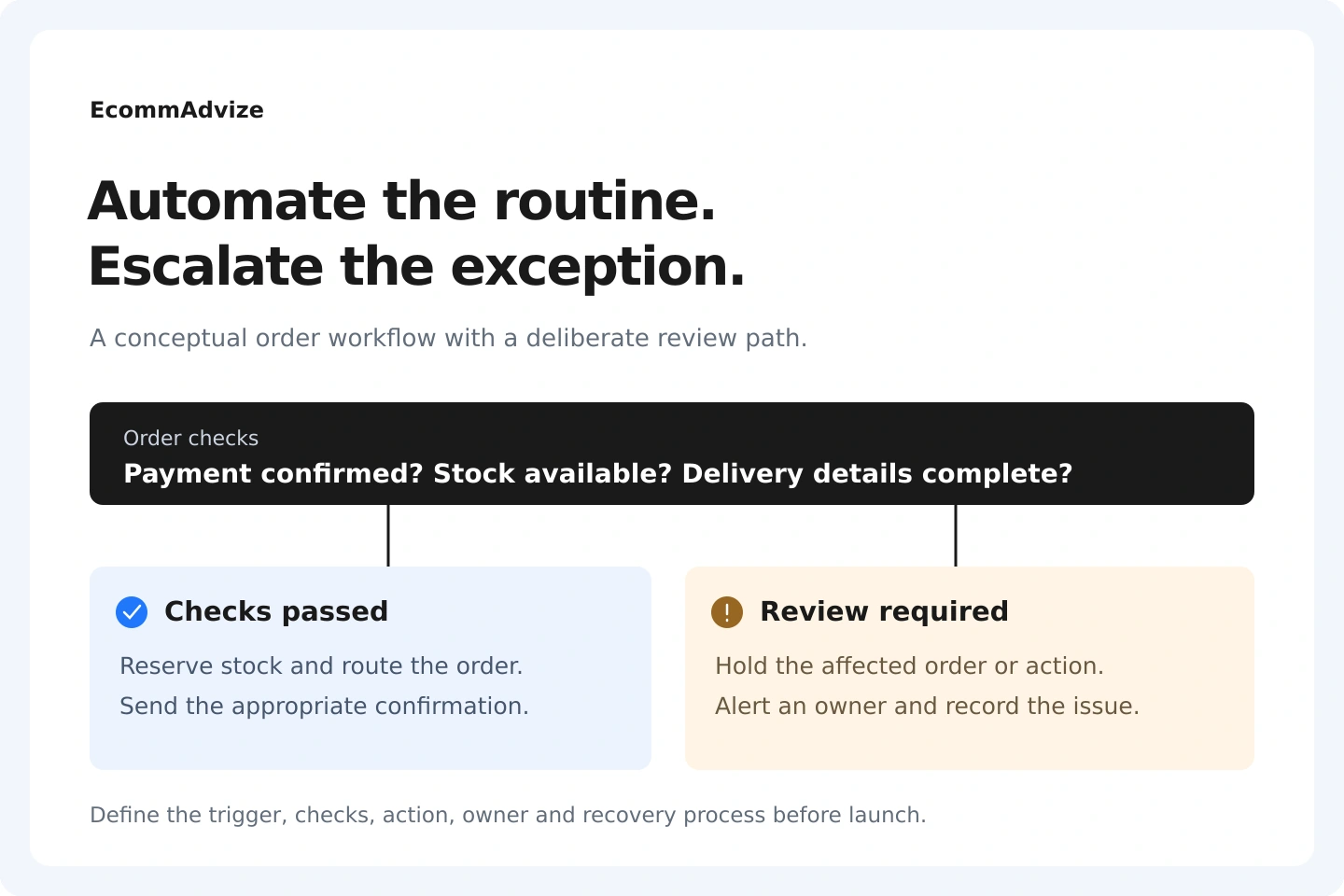
What happens when an order needs help?
Explore a conceptual workflow. The useful part of automation is knowing when to continue and when to pause for review.
- Receive & checkValidate the order, payment status and stock availability.
- Reserve & routeReserve available stock and send the order to the fulfilment system.
- Confirm & monitorSend the appropriate confirmation and monitor the hand-off.
A named owner still monitors failures, retries and duplicate messages.
Ecommerce Merchandising Automation
Ecommerce merchandising automation can help maintain product listings, organise product categories, identify missing attributes and update selected promotional rules.
For example, a retailer can establish rules for displaying in-stock products or flagging listings with missing images. AI may assist with product descriptions and categorisation, but human review remains important for accuracy and brand consistency.
The Best Ecommerce Automation Tools and Software
Choosing suitable technology requires more than comparing feature lists. Businesses should evaluate integration compatibility, scalability, reporting, security, support and total ownership costs.
The following categories of ecommerce automation tools serve different purposes.
| Tool category | Main purpose |
|---|---|
| Ecommerce platforms | Manage products, checkout and customer orders |
| Workflow integration software | Connect applications and trigger actions |
| CRM and marketing platforms | Manage customer data and campaigns |
| Inventory and order management | Synchronise stock and route orders |
| Warehouse management systems | Coordinate picking, packing and stock movements |
| Analytics and AI tools | Identify patterns and support decisions |
How AI Is Changing Ecommerce Automation
Artificial intelligence is expanding what businesses can automate. Traditional workflows follow predefined rules, while AI systems can also interpret text, classify information, identify patterns and generate recommendations.
DHL's 2025 ecommerce research reported that 55% of surveyed global ecommerce businesses used AI across their platforms. Its findings indicate that AI is becoming part of the wider digital commerce environment, although adoption and implementation vary by business.
Automated Ecommerce Personalisation
An automated ecommerce personalization experience uses customer preferences, browsing activity and purchase history to tailor product recommendations, messages and offers.
For example, a homeware retailer could recommend complementary products after a customer purchases a dining table. A subscription business could send replenishment reminders based on expected product usage.
These workflows support more relevant shopping experiences, but personalisation should respect customer consent and privacy requirements. Recommendations must also reflect available stock, product suitability and commercial objectives.
AI-Powered Marketing and Merchandising
An ecommerce marketing automation platform can segment audiences, schedule campaigns and trigger messages based on customer behaviour. Businesses can combine these capabilities with AI-generated content, predictive analytics and campaign performance monitoring.
The wider category of marketing automation tools for e-commerce includes email platforms, customer data systems, recommendation engines and advertising integrations. The most appropriate option depends on the business's channels, customer data and campaign requirements.
AI can also support product categorisation, search relevance and content maintenance. However, generated product claims and technical specifications require verification before publication.
Intelligent Automation and Emerging Technologies
Intelligent automation platforms e-commerce combine workflow automation with technologies such as machine learning, natural language processing and document processing. They may help classify customer enquiries, extract information from supplier documents or identify unusual transaction patterns.
IBM is one recognised technology provider in this field. Its IBM ecommerce related resources explain how automation technologies can support online retail processes. The relevant solution should be selected according to the specific business requirement rather than the provider's name alone.
How to Choose Ecommerce Automation Services
Some businesses have the technical resources to configure their own systems. Others require specialist guidance to connect platforms, redesign processes and establish governance.
Professional ecommerce automation services may include workflow audits, system integration, order management improvements, marketing automation configuration and performance reporting.
When evaluating ecommerce automation companies, businesses should assess whether providers understand their operating model, product catalogue, sales channels and growth objectives. A technically impressive implementation may still fail if it does not address the actual business problem.
A useful assessment should cover:
- Business process expertise: Can the provider identify unnecessary steps before automating them?
- Integration capability: Can the proposed systems exchange reliable information?
- Scalability: Will the architecture support additional products, orders and channels?
- Governance: Are permissions, approvals and exception handling clearly defined?
- Measurement: Can the business track time saved, errors reduced and financial impact?
- Ownership: Can internal employees maintain the workflows without unnecessary dependence on a supplier?
Real Figures: How to Measure Automation's Value
Automation should be evaluated through business results rather than the number of workflows deployed.
Consider a hypothetical retailer whose team processes 600 orders each week. If manual administration takes four minutes per order, the business spends 40 staff hours each week on that activity.
If automation reduces the average handling time to one minute, the task would require 10 hours weekly, saving 30 hours. This is an illustrative calculation, not a guaranteed industry benchmark. Actual results depend on exception rates, integration reliability and the amount of work that remains manual.
How much team capacity could you recover?
Use the article’s example or enter your own estimate. Include exception handling in the future average, then add regular monitoring time separately.
Planning estimate only. Recovered hours are capacity, not automatically cash savings. Software, implementation, maintenance and management costs still matter.
Businesses should monitor the following metrics:
| Metric | What it measures |
|---|---|
| Order processing time | Time between order receipt and processing |
| Inventory accuracy | Agreement between recorded and actual stock |
| Fulfilment error rate | Percentage of orders with processing or dispatch errors |
| Customer response time | Time taken to respond to enquiries |
| Marketing conversion rate | Percentage of eligible recipients or visitors who convert |
| Cost per order | Operational expense associated with each order |
| Return rate | Percentage of orders or items returned |
| Workflow failure rate | Percentage of automation runs requiring intervention |
For financial evaluation, the business can compare implementation and ongoing operating costs with verified savings.
A simple formula is:
Net financial benefit should account for measurable labour savings, avoided costs and incremental contribution, less the relevant costs included in the calculation. Businesses should avoid counting the same benefit twice.
How EcommAdvize Can Support Ecommerce Automation
Businesses often approach automation as a technology project. However, the greatest challenges may involve unclear responsibilities, disconnected channels, inconsistent reporting or processes that have not evolved alongside the business.
EcommAdvize approaches commerce through the relationship between strategy, platforms, operations and commercial performance. Its focus on growth strategy, marketplace transformation and operational scaling provides a relevant foundation for businesses reviewing their automation priorities.
The objective is not to automate every possible task. It is to create a more coordinated operation that can handle increasing complexity without unnecessary administrative effort. Businesses can explore the available services and strategic approach at EcommAdvize.
Frequently Asked Questions
1. What is ecommerce automation?
Ecommerce automation uses software, integrations and AI to handle repetitive online retail activities, including order processing, stock updates, marketing communications and customer support.
2. How can a small business automate its online store?
A small business can begin with order confirmations, inventory synchronisation, abandoned-cart emails and shipping notifications. It should prioritise workflows that save time, reduce errors and require minimal implementation effort.
3. Which ecommerce automation software is best?
The best option depends on the business's ecommerce platform, sales channels, order volume, budget and integration requirements. Businesses should compare functionality, scalability, support and total ownership costs before making a decision.
4. Can AI automate an entire ecommerce business?
AI can support many activities, including customer service, product recommendations, content classification and demand forecasting. However, financial decisions, compliance, unusual customer cases and strategic planning often require human oversight.
5. How much does ecommerce automation cost?
Costs vary according to the number of systems, integration complexity, subscription fees, implementation work and ongoing maintenance. A business should define its objectives and estimate potential savings before committing to a solution.
6. Does ecommerce automation improve profitability?
It can improve profitability when it reduces avoidable costs, prevents errors or increases operational capacity. However, software expenses, poor implementation and unnecessary automation can reduce the financial benefit.
MIT CTL: Current State of eCommerce provides the survey context for the 81% figure, covering perceived ecommerce growth during 2025. DHL: 2025 E-Commerce Trends Report, Business Edit provides the 55% AI-adoption figure. These are survey findings, not forecasts for an individual retailer.
Hero and workflow diagrams: original EcommAdvize graphics created for this article. Kingdom artwork and project details: EcommAdvize Case Studies CMS.


