


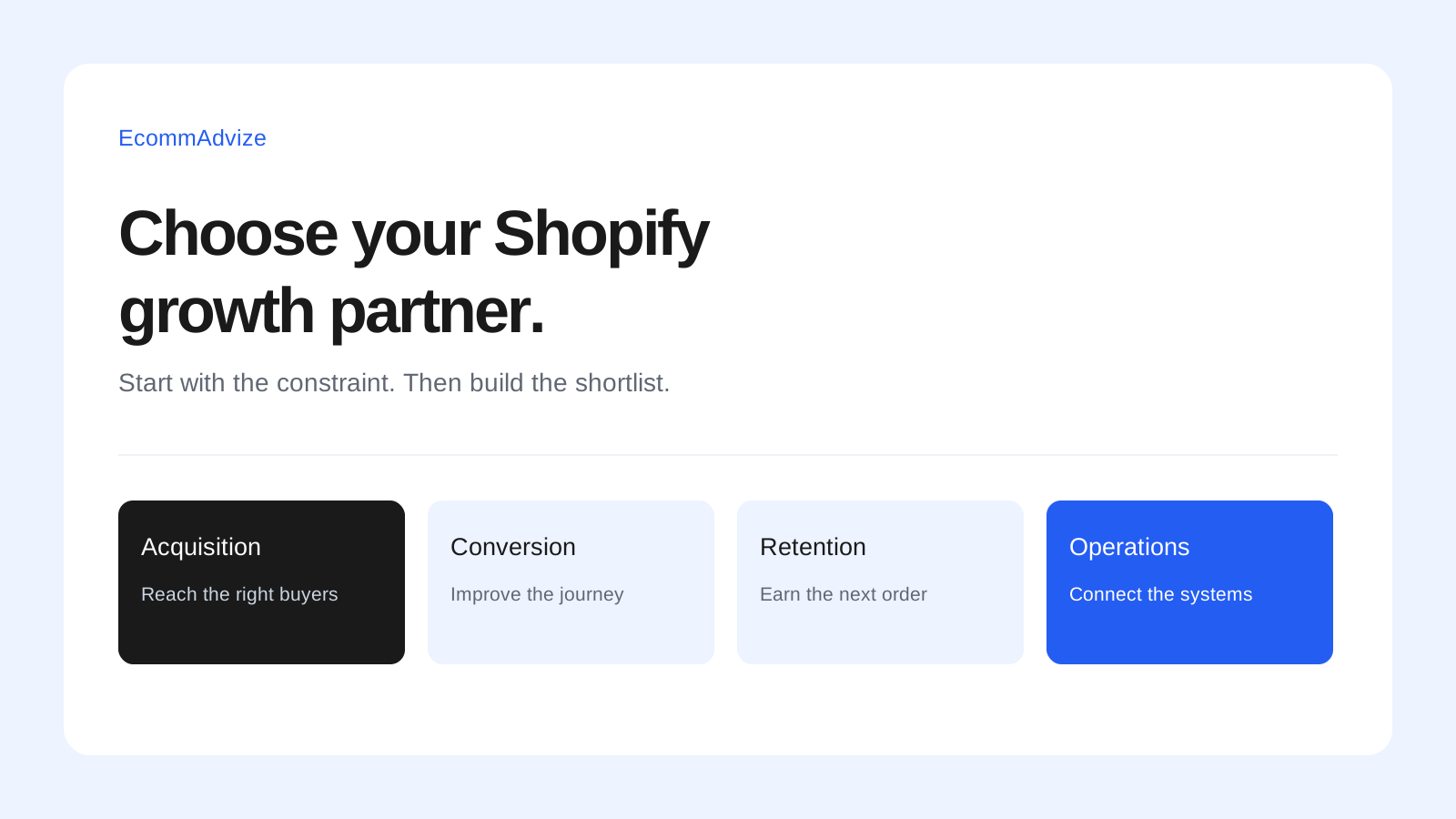


Choosing the right shopify agency can help an ecommerce business improve its online store, attract qualified customers, increase conversions, and build a more sustainable growth strategy. However, not every agency offers the same expertise. Some focus on store design and development, while others specialise in conversion rate optimisation, paid advertising, customer retention, or enterprise commerce transformation.
In 2026, ecommerce brands need more than an attractive storefront. They need connected strategies that align customer acquisition, product availability, website performance, customer experience, and profitability. Businesses must also understand how advertising costs, repeat purchases, and operational efficiency affect their long-term results.
The right agency should therefore match a brand's commercial objectives, technical requirements, and stage of growth. This guide explores established Shopify service providers, their areas of specialisation, and the factors ecommerce businesses should evaluate before choosing a partner.

How This Guide Was Researched
This guide was researched by reviewing Shopify's official investor information, its published merchant case studies, agency service positioning, and the different capabilities businesses commonly need when scaling an online store. The research prioritises publicly available information, specialist expertise, and measurable business outcomes rather than unsupported rankings. Agency descriptions should be checked against current service pages, client references, and Shopify's official partner directory before a purchasing decision. The comparison is intended to help readers build a relevant shortlist, not to suggest that every provider suits every business.
Why Shopify Marketing Agencies Matter in 2026
Shopify continues to play a significant role in global commerce. According to its 2025 annual report, the platform facilitated approximately $378.4 billion in gross merchandise volume (GMV) during 2025, representing a 29% increase from 2024. Shopify also reported annual revenue of approximately $11.6 billion, up 30% year over year. These figures demonstrate the scale of activity across its ecosystem, although they do not guarantee growth for individual merchants.
As competition increases, brands need to improve the entire customer journey. A slow website, confusing navigation, poor product information, or expensive acquisition strategy can limit the value of otherwise strong marketing campaigns.
Experienced shopify agencies can help businesses address these challenges through services such as:
- Shopify store design and development.
- Search engine optimisation and content strategy.
- Paid search and paid social advertising.
- Conversion rate optimisation (CRO).
- Email marketing and customer retention.
- Analytics, reporting, and commercial performance improvement.
Best Shopify Marketing Agencies to Consider in 2026
The following providers represent different approaches to Shopify development, enterprise commerce, and ecommerce growth. They are presented as a research-based shortlist rather than a definitive ranking. Businesses should verify current capabilities, availability, pricing, and client results before appointing an agency.
1. BORN: Enterprise Ecommerce and Digital Transformation
BORN, formerly known as We Make Websites, is associated with enterprise ecommerce delivery and digital commerce transformation. Its historical positioning makes it a potential candidate for established brands seeking support with complex ecommerce programmes.
A business considering an enterprise-focused shopify agency partner should assess its experience with replatforming, integrations, international storefronts, product information, and cross-functional commerce operations.
This type of provider may be suitable for organisations that need more than a standard theme redesign. However, the precise scope should be confirmed, particularly when the project involves Shopify Plus, business-to-business functionality, or complex system integrations.
2. Swanky: Shopify Plus and Subscription Commerce
Swanky is known for Shopify-focused ecommerce services, including Shopify Plus and subscription-related projects. Subscription businesses often require specialised customer journeys, recurring payment functionality, retention strategies, and integrations with third-party applications.
For brands selling replenishable products, food, beauty, or other repeat-purchase categories, the agency evaluation should examine how the proposed solution supports customer lifetime value, subscription management, and operational reliability.
Businesses searching for best shopify plus agencies 2026 should request evidence of relevant subscription projects rather than relying on broad claims about ecommerce expertise.
3. Absolute Web: Complex Ecommerce Projects
Absolute Web is an ecommerce agency that businesses may consider when comparing providers for advanced store development, redesigns, and digital commerce initiatives.
Brands evaluating a shopify development agency should investigate its ability to handle migration planning, custom functionality, third-party integrations, performance testing, and post-launch support. These capabilities become especially important when a store contains extensive product catalogues or relies on multiple operational systems.
A structured discovery process should establish the project's technical requirements before the agency recommends a platform architecture or development approach.
4. Solo Media Group: Ecommerce Growth and Performance Marketing
Solo Media Group is another provider to investigate when the main requirement involves ecommerce growth and performance marketing.
Businesses considering a shopify growth agency should examine its approach to acquisition costs, campaign measurement, creative testing, landing-page optimisation, and repeat purchases. Paid advertising can increase traffic quickly, but sustainable performance depends on the quality of that traffic and the store's ability to convert it profitably.
Before signing a contract, brands should request clearly defined reporting metrics and examples of work relevant to their category, revenue scale, and acquisition channels.
5. Maze: B2B Ecommerce and Complex Buying Journeys
Maze is worth investigating for businesses that require more sophisticated B2B ecommerce experiences. Shopify's published case studies include a project in which Maze helped Speclite Technologies develop a B2B store featuring account-specific pricing, credit controls, technical product information, and streamlined ordering.
This example demonstrates why B2B ecommerce requires more than a visually appealing storefront. Business customers may need customised catalogues, account permissions, purchasing workflows, and connections to existing systems.
Companies searching for a shopify ecommerce agency for b2b should therefore prioritise commercial workflows, integration experience, and the needs of professional buyers.

Comparing Shopify Agency Services
| Agency or provider | Potential area of focus | What to verify |
|---|---|---|
| BORN | Enterprise commerce and transformation | Migration experience, integrations, and project governance |
| Swanky | Shopify Plus and subscription commerce | Recurring revenue functionality and retention expertise |
| Absolute Web | Ecommerce development and complex projects | Technical delivery, support, and platform requirements |
| Solo Media Group | Ecommerce growth and performance marketing | Campaign profitability, attribution, and CRO |
| Maze | B2B commerce experiences | Account-based pricing, purchasing workflows, and integrations |
This comparison is a starting point for further research, not an independently audited assessment of agency performance.
How to Choose the Best Shopify Agency for an Ecommerce Brand
Selecting the right partner requires a clear understanding of the business's priorities. A best shopify agency for a start-up may not have the right structure for a multinational retailer. Likewise, a technically strong developer may not provide the commercial strategy required by an established brand.
1. Define the Business Objective
The first step is to identify the primary challenge. Is the business struggling to acquire customers, convert visitors, retain existing buyers, or manage a complex technology stack?
A brand that needs a new storefront should evaluate a shopify design agency or development specialist. A mature retailer with rising acquisition costs may need a partner focused on analytics, retention, and conversion optimisation.
2. Evaluate Technical Expertise
A reliable shopify development agency should demonstrate experience with theme development, APIs, integrations, migration planning, and performance testing. Businesses considering Shopify Plus should also assess enterprise functionality, international commerce, and B2B requirements.
For complicated projects, the best shopify development partner for complex ecommerce migrations will be one that can explain the migration process, data validation, redirects, testing procedures, and contingency plans.
3. Review Verifiable Results

This Amazon engagement illustrates why agencies should be assessed through documented project outcomes. For a Shopify appointment, also request evidence of relevant Shopify delivery.
4. Understand Reporting and Accountability
Every engagement should establish clear performance indicators. Depending on the project, these may include:
- Conversion rate and average order value.
- Customer acquisition cost (CAC).
- Return on advertising spend (ROAS).
- Customer lifetime value (CLV).
- Repeat purchase rate.
- Contribution margin and net profitability.
5. Check Communication and Ongoing Support
An ecommerce store requires continuous improvement after launch. Product updates, app compatibility, campaign changes, technical issues, and seasonal demand can all affect performance.
Before choosing a full service shopify agency, businesses should clarify who manages the account, how frequently results are reviewed, what the monthly fee includes, and whether development support is available after the initial project.
Shopify Marketing, Design, and Development: Understanding the Difference
Although the services often overlap, different agency models solve different problems.
A shopify advertising agency typically concentrates on paid acquisition through channels such as Google Ads and Meta Ads. A shopify design agency focuses on visual identity, usability, navigation, and customer experience. A shopify web agency may combine design and development, while a growth-focused partner connects acquisition, conversion, retention, and commercial measurement.
For larger organisations, shopify plus agencies may offer additional experience in enterprise migrations, advanced integrations, multi-market operations, and complex B2B purchasing journeys.
The distinction matters because businesses can otherwise pay for services that do not address their biggest constraints. For example, increasing advertising expenditure may not improve profitability if product availability, checkout usability, or customer retention remains weak.
Store and systems
When the buying experience or technology limits progress.
Demand and retention
When attracting or retaining profitable customers is the priority.
What Should Ecommerce Brands Expect From Shopify Agency Costs?
Agency pricing varies according to scope, expertise, location, and the complexity of the engagement. A straightforward theme implementation usually requires fewer resources than an enterprise migration involving several systems, multiple markets, and extensive custom functionality.
Businesses should compare proposals according to deliverables rather than headline prices alone.
A useful proposal should specify:
- Discovery, research, and strategic planning.
- Design, development, and integration requirements.
- Campaign management and optimisation responsibilities.
- Reporting frequency and agreed performance measures.
- Maintenance, support, and additional service charges.
Why Connected Commerce Matters for Shopify Growth
Successful ecommerce growth depends on more than the storefront. Marketing performance is affected by inventory availability, product information, fulfilment processes, customer service, and reporting quality.
For example, a campaign may generate strong demand for a product that is running low in stock. If marketing, inventory, and operations teams work separately, the business may waste advertising expenditure or disappoint customers.
Connected commerce brings these activities together. It allows businesses to evaluate how decisions across technology, people, platforms, and operations influence the overall customer experience and financial performance.
This approach is especially relevant to established brands operating across Shopify, marketplaces, wholesale channels, and international markets. A growth partner should understand these relationships rather than treating every sales channel as an isolated project.
How EcommAdvize Supports Ecommerce Growth
EcommAdvize approaches commerce through connected strategy, operational performance, marketplace transformation, technology, and business growth. Its work is relevant to brands that need to align their digital channels and commercial processes rather than focusing exclusively on advertising or storefront design.
Through its solutions, EcommAdvize helps businesses consider how customer acquisition, platform capabilities, data, automation, and operational efficiency contribute to sustainable performance.
Businesses evaluating a shopify growth agency should consider this broader perspective when their challenges extend beyond website traffic. Improving commercial visibility, reducing disconnected workflows, and strengthening decision-making can be important parts of a long-term growth plan.
To explore its approach and services, visit EcommAdvize.
Final Thoughts
The best Shopify partner is not necessarily the largest agency or the one with the longest service list. It is the provider whose experience, capabilities, and working approach match the business's commercial objectives.
In 2026, ecommerce brands should look beyond website launches and advertising campaigns. They should assess how an agency supports customer experience, conversion, retention, operational efficiency, and profitability.
By reviewing relevant case studies, comparing service scopes, checking partner credentials, and establishing measurable objectives, businesses can build a shortlist of suitable providers. A thoughtful selection process helps ensure that technology and marketing investments support long-term commercial performance rather than short-term activity alone.
Frequently Asked Questions
1. What does a Shopify marketing agency do?
A Shopify marketing agency helps ecommerce businesses attract relevant customers and improve sales through services such as SEO, paid advertising, email marketing, analytics, and conversion rate optimisation. Some providers also offer store design and development.
2. How can a business find the best Shopify agency?
Businesses should define their goals, review relevant case studies, verify technical expertise, compare proposals, and check references. Shopify's official Partner Directory can help merchants explore providers by service, location, industry, and partner tier.
3. Are Shopify Plus agencies suitable for growing brands?
Shopify Plus specialists may suit businesses that need advanced functionality, complex integrations, international expansion, or sophisticated B2B purchasing workflows. The appropriate solution depends on the brand's operational requirements and growth plans.
4. Should a business choose a marketing agency or a development agency?
A marketing agency is generally more suitable when the main challenge involves customer acquisition, campaign performance, or retention. A development agency is more appropriate when the business needs technical implementation, redesign, integrations, or migration. Some providers combine both capabilities.
5. How should Shopify agency performance be measured?
Performance should be evaluated against agreed objectives, including conversion rate, customer acquisition cost, ROAS, repeat purchases, and contribution margin. The most relevant measures depend on the engagement, and results should be compared with a reliable baseline.
6. Can a Shopify agency help with B2B ecommerce?
Yes. Specialist providers can help implement account-based pricing, customer permissions, customised catalogues, purchasing workflows, and integrations. Businesses should verify the provider's experience with their specific B2B requirements.
7. What should a business check before signing an agency contract?
The business should confirm the scope, deliverables, timeline, payment structure, ownership of assets, reporting arrangements, support terms, and cancellation conditions. It should also clarify how performance will be evaluated and which services require additional fees.
Reviewed 6 November 2026. EcommAdvize publishes this guide and offers commerce services. Agency scope and availability should be confirmed directly.


